

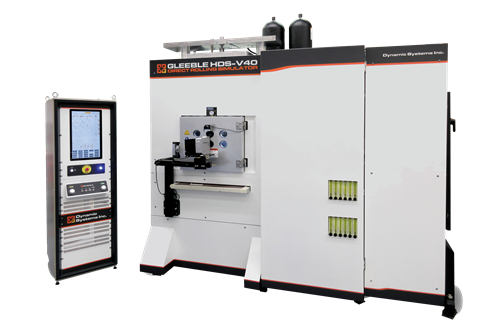
GLEEBLE HDS-V40 SYSTEM
The World's Only Commercially Available CC-DR Simulator
The Gleeble HDS-V40® is the definitive direct rolling simulator — a 40-ton hydraulic plane strain compression system enabling the complete continuous casting direct rolling (CC-DR) process in a single laboratory specimen. From in situ melting and solidification through multi-stand hot deformation, no other commercially available instrument replicates the full CC-DR thermo-mechanical history.

THE WORLD'S ONLY CC-DR SIMULATOR IS READY FOR YOUR PROGRAM
Speak with a Gleeble applications engineer to discuss how the HDS-V40 can accelerate your CC-DR process development, semi-solid rolling research, or thermo-mechanical simulation program. We offer technical consultations, demonstration experiments, and full application support.
WHY THE HDS-V40
Develop Steel Processes Without the Cost and Risk of Pilot Mill Trials
Developing and optimizing continuous casting and direct rolling (CC-DR) processes at the mill scale is extraordinarily expensive, disruptive, and time-consuming. Traditional pilot mills require large steel heats, dedicated caster time, and carry significant production risk. Numerical models can approximate deformation behavior but cannot replicate the real microstructural evolution, phase transformations, and thermo-mechanical interactions present in actual CC-DR processing.
The HDS-V40 Gleeble system solves this problem definitively. As the world's only laboratory system for continuous casting direct rolling simulation integrating direct resistance heating for large specimen deformation, the HDS-V40 allows materials and process engineers to simulate the thermal and mechanical history of the CC-DR route — from the liquid metal core of the continuous caster through to the finishing stands of the hot strip mill — in a controlled, repeatable, high-fidelity laboratory environment.
"Simulate melting, solidification, semi-solid deformation, and multi-stand hot rolling on a single specimen — physically, not just computationally."

MAX COMPRESSION FORCE
40T

MAX STROKE RATE
1,700 mm/s

MAX TEMPERATURE
1,550°C

DATA SAMPLING RATE
50 kHz
RESEARCH PAIN POINTS RESOLVED
Optimizing continuous casting and direct rolling processes for your testing.

Pilot Mill Costs Are Prohibitive
Full-scale CC-DR trials require hundreds of tonnes of steel and week-long equipment allocation.

Modeling Lacks Physical Fidelity
FEM and CFD cannot replicate real microstructural evolution, segregation, or phase transformation kinetics.

No Integrated Melt-Deform Equipment
Conventional furnaces and deformation testers are separate — no single platform handles the full CC-DR sequence.

Data Quality Limits Confidence
Without high-speed synchronized thermal and mechanical data, process optimization remains guesswork.

Semi-Solid Deformation Is Inaccessible
Laboratory replication of liquid metal core reduction has historically been impossible without specialized equipment.

EXPLORE THE NEXT GENERATION OF MATERIALS TESTING
Download the Gleeble HDS-V40 System brochure to read more about the only continuous casting direct rolling system.
SYSTEM OVERIEW
What Is the Gleeble HDS-V40?
The HDS-V40 is a purpose-built thermo-mechanical simulation platform combining a 40-ton hydraulic press, Gleeble direct resistance heating, and multi-hit plane strain compression capability into the world's definitive CC-DR process optimization laboratory.
40-Ton Hydraulic Plane Strain Deformation Simulator
With a maximum static compression force of 40,000 kgf (392 kN) and dual opposed rams achieving up to 1,700 mm/s combined stroke velocity, the HDS-V40 delivers the deformation loads required for realistic multi-stand rolling mill simulation on laboratory-scale specimens — far exceeding what a standard Gleeble or servo-hydraulic test frame can provide for CC-DR geometries.
Direct Resistance Heating for In Situ Melting and Solidification
Gleeble's proprietary direct resistance heating technology delivers extraordinarily precise
thermal control — up to 1,550°C with ±1°C closed-loop accuracy. Unlike induction or furnace heating, direct resistance allows the specimen itself to generate heat uniformly, enabling true in situ melting and controlled solidification before deformation commences. This is the cornerstone of semi-solid rolling simulation from the continuous caster.
Multi-Hit Hot Rolling and Multi-Stand Rolling Mill Simulation
The HDS-V40 supports unlimited sequential compression hits with programmable interpass time, temperature, and strain — precisely replicating rolling schedules from roughing to finishing stands. This makes it the defining multi-stand rolling mill simulation lab instrument, capable of developing interpass recrystallization, precipitation, and grain refinement strategies without leaving the laboratory.
Full CC-DR Sequence in a Single Experiment
What makes the HDS-V40 by Gleeble uniquely powerful is the ability to execute the entire CC-DR thermo-mechanical history on one specimen, without transfer between apparatus. The specimen is melted, solidified under controlled conditions, then subjected to the hot deformation schedule of the rolling mill — all within one continuously logged, synchronized experimental run. Commercially available nowhere else.
TECHNICAL SPECIFICATIONS
Complete performance specifications for the Gleeble HDS-V40 continuous casting direct rolling simulation system.
|
Specifications |
Gleeble HDS-V40 |
|
Mechanical System |
|
|
Maximum Static Force |
Compression: 40,000 kgf (~88,184 lbf) / 392 kN |
| Max Stroke Rate — Both Rams | 1,700 mm/s (66.92 in/s) |
| Max Stroke Rate — Each Ram | 850 mm/s (33.47 in/s) |
| Minimum Stroke Rate | 0.005 mm/s (1.96×10⁻⁴ in/s) |
| Maximum Combined Stroke Distance | 40 mm (1.57 in) |
| Maximum Compression Hits | No Specific Limit |
| Deflection | 0.076 mm (0.003 in) |
|
Force Measurement |
|
|
Accuracy |
±0.5% of full scale |
|
Resolution |
±1.5 kgf (3.2 lbf) / 0.014 kN |
|
Response Time |
0.1 msec |
|
Thermal System |
|
|
Heating Type |
Direct Resistance, Closed-Loop |
|
Temperature Controller |
Digital closed-loop, 18-bit ADC, 32-bit processor |
| Temperature Range | Room Temp to 1,550°C (2,822°F) |
| Monitoring Source | Thermocouple |
| Resolution | ±1°C or °F |
| Control Accuracy | (Steady State) ±1°C or °F |
| Measurement Accuracy | ±1°C or °F or ±1% + thermocouple accuracy |
|
Data Acquisition System |
|
|
Channels |
User selectable, up to 16 simultaneous |
|
ADC Resolution |
18-bit |
| Sampling Rate | User selectable, up to 50 kHz |
HOW TO SIMULATE THE DIRECT ROLLING PROCESS IN THE LABORATORY
The HDS-V40 replicates the full CC-DR route — a process sequence previously impossible to study in a laboratory without a pilot caster and rolling mill. The entire sequence is executed on a single specimen, in situ, within one uninterrupted experiment.
Step 01
- Specimen Prep
- Bulk steel specimen sized for plane strain geometry
Step 02
- In Situ Melting
- Direct resistance heating above liquidus; controlled melt pool
Step 03
- Solidification
- Programmed cooling replicating the continuous caster thermal profile
Step 04
- Semi-Solid Deformation
- Liquid metal core reduction — strand reduction at caster exit
Step 05
- Roughing Passes
- High-temperature multi-hit compression with interpass reheating
Step 06
- Finishing Mill
- Controlled strain, strain rate, temperature, and interpass time
Result
- Process Validated
- Microstructure, texture, and mechanical property data — one reproducible run
Key Insight: Because the HDS-V40 applies Gleeble direct resistance heating, each step is thermally controlled to ±1°C — providing thermal fidelity to real CC-DR plant data that no furnace-based or induction-heated system can match.
WHAT THE HDS-V40 IS USED FOR
The HDS-V40 addresses the most demanding physical simulation challenges in steel process metallurgy and product development, spanning fundamental research through production-scale process optimization.
CC-DR Process Development
CC-DR Process Optimization
Steel producers and research institutes use the HDS-V40 to develop and optimize continuous casting direct rolling schedules for flat products, long products, and specialty steels. Rolling reduction ratios, interpass times, and temperature profiles can be systematically varied to determine optimal processing windows before committing to costly mill trials.
Semi-Solid Rolling
Semi-Solid Rolling Laboratory Research
The liquid metal core reduction (LMCR) stage — where the steel strand retains a partially solidified core — is one of the most complex stages in steel processing. The HDS-V40 is the only commercially available semi-solid rolling laboratory equipment and liquid metal core reduction simulator that allows researchers to study thermomechanical behavior at this transitional state under realistic deformation conditions.
Hot Rolling & Forging
Physical Simulation of Hot Rolling and Multi-Hit Forging
Beyond CC-DR, the HDS-V40 functions as a high-capability hot rolling physical simulator and hot forging simulation machine for any steel grade requiring high-load, high-temperature multi-hit deformation testing. Its 40-ton hydraulic capacity and 1,700 mm/s ram velocity enable realistic strain rates for HSLA, stainless, tool steels, and advanced high-strength steels (AHSS).
Steel Process Development
Thermo-mechanical Simulation of Steel Processing Routes
The HDS-V40 enables thermo-mechanical simulation of steel processing for TMCP, intercritical rolling, direct quenching, accelerated cooling optimization, and precipitation engineering. Researchers can map transformation behavior, DIFT microstructures, and mechanical property outcomes across parametric combinations with efficiency and repeatability only physical simulation delivers.
Physical Simulation vs. FEM
Physical Simulation vs. Numerical Modeling for CC-DR
Physical simulation in the HDS-V40 captures actual grain boundary evolution, precipitation kinetics, recrystallization dynamics, segregation effects, and solidification microstructure in real material — providing experimental data that validates and calibrates numerical models for CC-DR, where multi-physics complexity is extreme. FEM and CFD alone cannot replicate real thermodynamic-kinetic metallurgical behavior.
Pilot Mill Alternative
HDS-V40 vs. Pilot Mill Testing
A single HDS-V40 experiment can explore 10–20 process variants in the time a pilot mill trial would require for one. For early-stage process screening, new grade development, and research programs where parametric breadth is essential, the HDS-V40 delivers superior data richness per unit cost — making it the preferred steel process development equipment for universities, national labs, and R&D centers globally.

FIND OUT MORE ABOUT THE HDS-V40 SYSTEM
Get answers to common questions about our continuous casting direct rolling process for in situ melting and solidification through multi-stand hot deformation.
STILL HAVE QUESTIONS? CONTACT OUR TEAM
Let us know if you're ready for the industry's only commercially available CC-DR thermo-mechanical system.