


WHY UNIVERSITIES CHOOSE GLEEBLE FOR ADVANCED MATERIAL RESEARCH
Gleeble systems are a capital equipment anchor for many of the world's leading university materials science labs; built for research and proven in hundreds of peer-reviewed publications.
Where Academic Rigor Meets Industrial-Grade Precision
Materials science research demands much more than a simple furnace and load cell. Faculty and graduate researchers need reliable thermomechanical simulation data that is reproducible, publication-quality, and fundable; data that moves the needle from hypothesis to breakthrough. Gleeble systems have delivered exactly that for over 65 years.
For over six decades, Gleeble has been the trusted platform for university materials labs conducting research in metal forming, welding metallurgy, phase transformation, hot workability, and advanced alloy development across the globe. Whether you are building the case for a shared instrumentation grant, pursuing an grant award, or managing a multi-PI capital equipment request, Gleeble systems have been recognized time and again by federal review panels and grant proposal entities as essential, high-impact research infrastructure.
Our team of Gleeble experts have provided universities with dedicated application support, grant letter assistance, reference networks, and training infrastructure — making Gleeble not just a testing system, but a partnership that advances your research program for decades.

TALK TO AN EXPERT ON METALLURGICAL RESEARCH
Ready to validate critical components and accelerate certification? Contact our team to discuss your automotive testing and simulation needs.
CORE CAPABILITIES
What the Gleeble Platform Delivers
Six decades of innovation distilled into the most capable thermo-mechanical physical simulator in university materials research.

Precision Thermal & Thermo-Mechanical Simulation
Gleeble enables unmatched control of temperature and mechanical loading in a single system, allowing researchers to replicate real-world processing and service conditions with high fidelity. This combined capability is essential for accurately simulating how materials behave under extreme environments.
-
Rapid heating rates up to 10,000°C/s with precise temperature control
-
Controlled cooling, isothermal holds, and multi-thermocouple feedback
-
Simultaneous thermal and mechanical loading (tension, compression, torsion)
-
Wide strain rate capability from quasi-static to dynamic conditions
-
Real-time replication of industrial thermal cycles, including weld HAZ
High-Fidelity Material Characterization & Data Acquisition
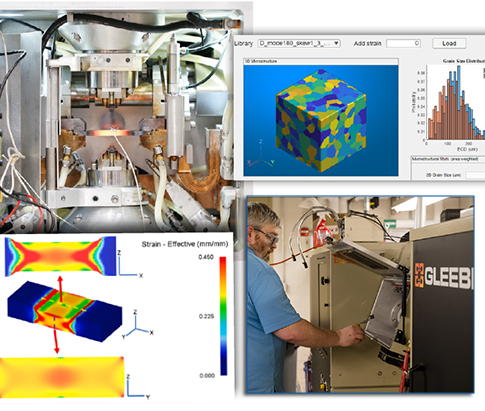
Gleeble delivers synchronized, research-grade data that captures the full material response during testing, enabling deeper insight into deformation and phase transformation behavior. The result is accurate, publication-ready datasets that support both experimental analysis and model validation.
-
Synchronized multi-channel data capture (force, displacement, temperature, dilatometry)
-
Integrated dilatometry for phase transformation and kinetics analysis
-
Real-time CCT/TTT generation and phase detection
-
Flow stress, deformation behavior, and processing map development
-
Exportable, publication-ready datasets for model validation
Process Modeling & Research Infrastructure Integration
Gleeble bridges experimental research and computational modeling while supporting collaborative, multi-user environments. It provides the tools and data needed to integrate physical simulation directly into modern materials research workflows.
-
Constitutive data generation for FEM and ICME modeling workflows
-
Simulation of rolling, forging, and advanced forming processes
-
Modular, multi-user platform for diverse research applications
-
Intuitive test programming, data management, and training support
-
Designed for shared labs, collaborative research, and graduate education
The Gleeble Advantage: Why Universities Choose Gleeble
No other platform combines thermal precision, mechanical capability, and data fidelity in a single instrument — with the institutional track record to satisfy the most rigorous federal grant review panels. When reviewers evaluate capital equipment requests, they look for proven impact, broad user base, and instrument uniqueness. Gleeble checks every box — with 10,000+ publications as evidence.
Gleeble delivers unmatched thermal–mechanical coupling by precisely controlling temperature and mechanical loading simultaneously, eliminating the data inconsistencies common in single-axis systems. The result is synchronized, calibrated, and fully traceable datasets that meet the rigorous standards of top-tier journals and support high-confidence experimental conclusions. This level of data quality, combined with Gleeble’s extensive presence in published research, makes it a familiar and trusted platform among federal funding agencies, strengthening proposals for capital equipment and research programs.
Beyond performance, Gleeble offers long-term institutional value and broad research utility. Systems installed decades ago continue to produce publication-quality data, demonstrating exceptional longevity and return on investment. Its versatility enables shared use across materials science, mechanical engineering, aerospace, nuclear, and other disciplines, aligning with multi-investigator funding models. Complementing this, Gleeble’s academic program provides direct support for grant applications, including documentation, justification materials, and expert guidance—helping institutions secure funding and maximize the impact of their research infrastructure.
Proven Solutions for University Materials Labs
From undergraduate senior theses to government-funded multi-year research programs, Gleeble supports every level of the academic research enterprise.
Graduate Research & Data Integrity
Gleeble provides Ph.D. students and researchers with reproducible, defensible data by eliminating variability through closed-loop thermal and mechanical control. Unlike conventional furnace-and-press setups, where operator technique and thermal lag introduce uncertainty, Gleeble ensures that identical test conditions produce consistent results across specimens and users. This gives graduate researchers confidence in their conclusions, strengthens thesis defense outcomes, and produces methods sections that stand up to rigorous peer review.
Computational Model Validation
Gleeble generates the high-quality experimental data required to validate computational materials models, including fully synchronized measurements of temperature, strain, stress, and phase transformation behavior. These datasets provide the physical grounding that ICME (Integrated Computational Materials Engineering) and CALPHAD (Calculation of Phase Diagrams)-based research demands, enabling accurate calibration of constitutive models and simulation workflows. By closing the gap between modeling and experiment, Gleeble helps researchers produce results that are both computationally advanced and experimentally credible.
Shared Research Infrastructure & Grant Enablement
A single Gleeble system supports a wide range of materials research applications—from welding and additive manufacturing to hot deformation and phase transformation studies—making it an ideal anchor for multi-investigator labs. Its versatility allows multiple departments to share one platform without reconfiguration, helping institutions demonstrate high utilization in competitive equipment proposals. Combined with its proven longevity and widespread recognition, Gleeble strengthens grant applications and supports long-term research program growth.
Industry Collaboration & Workforce Development
Gleeble enables universities to produce industry-relevant data in formats directly usable by engineering teams, including flow stress curves, transformation diagrams, and weld simulation results. This strengthens partnerships with industrial sponsors who require actionable, process-ready data, making research programs more competitive for funded collaborations. At the same time, students gain hands-on experience with equipment widely used in industry, building practical skills that improve employability and align with workforce development priorities in both government and private sectors.
University Research Papers Using Gleeble
A Legacy of High-Impact Academic Publications
Over 30,000 peer-reviewed publications cite Gleeble-generated data.
 Ready to Build the Materials Lab Your Research Deserves?
Whether you are beginning a grant proposal, evaluating capital equipment options, or ready to specify a system — Gleeble's academic team is ready to support your program at every step.