


PRECISION HEATING FOR THERMO-MECHANICAL SIMULATION & MATERIALS TESTING
Replicate real-world thermal cycles with unmatched speed, accuracy, and control
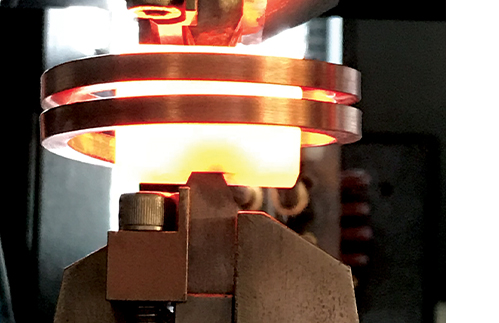 Gleeble Systems deliver unmatched thermal control for physical simulation materials testing — from standard Direct Resistance Heating to advanced Induction Heating — enabling researchers and engineers to replicate real-world thermal conditions with laboratory precision.
Modern materials development demands heating systems that can keep pace with real manufacturing conditions. From ultra-fast thermal cycling to precise temperature uniformity and synchronized mechanical loading, advanced heating is essential for producing accurate, repeatable, and actionable test data.
Gleeble Systems deliver unmatched thermal control for physical simulation materials testing — from standard Direct Resistance Heating to advanced Induction Heating — enabling researchers and engineers to replicate real-world thermal conditions with laboratory precision.
SOLVING THE TOUGHEST CHALLENGES IN HIGH-TEMPERATURE MATERIALS TESTING AND SIMULATION
Traditional furnace heating methods are slow, imprecise, and incapable of replicating the rapid thermal cycles experienced by materials in real industrial processes. Gleeble's thermo-mechanical simulators eliminate these limitations with closed-loop heating systems engineered for repeatability, speed, and scientific accuracy.
- Insufficient heating rates that fail to replicate real industrial thermal cycles
- Poor temperature uniformity across the gauge length during high-temperature testing
- Inability to test non-conductive materials with standard resistance heating setups
- Lack of synchronized thermo-mechanical control needed for valid physical simulation
- Long thermal ramp times disrupting test throughput and research timelines

READY TO ADVANCE YOUR MATERIALS TESTING PROGRAM?
Upgrade from traditional furnace limitations with Gleeble’s precision heating solutions for thermo-mechanical simulation. Our applications engineers will help you configure the right system or upgrade to match your testing requirements.
TWO OPTIONS. ONE UNCOMPROMISING STANDARD.
Select the heating configuration that matches your materials testing requirements — or deploy both on the same Gleeble platform.
DIRECT RESISTANCE HEATING
Standard — Closed-loop resistive thermal control included with every Gleeble
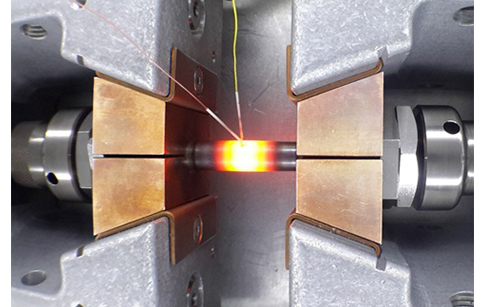
Gleeble's Direct Resistance Heating is the foundation of every thermo-mechanical simulator in the Gleeble product line. By passing high-amperage electrical current directly through the specimen, heat is generated resistively at the sample itself — eliminating thermal lag, enabling extraordinary heating rates, and allowing true closed-loop temperature control via thermocouple feedback.
- Heating rates up to 10,000 °C/s for ultra-rapid thermal cycling
- Closed-loop resistance heating controlled via weld-attached thermocouples
- Uniform hot zone across the specimen gauge length
- Fully synchronized with mechanical loading in real time
- Applicable to steels, aluminum alloys, titanium, nickel superalloys, and more
- Standard on all Gleeble systems
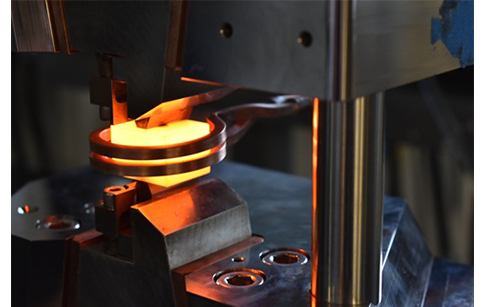
INDUCTION HEATING
Upgrade — Gleeble Induction Heating System
The Gleeble Induction Heating upgrade extends the capabilities of any Gleeble thermo-mechanical simulator to accommodate non-conductive materials — including metal matrix composites, coated specimens and much more— where Direct Resistance Heating is not applicable. This upgrade integrates seamlessly with the existing Gleeble control architecture, preserving the system's closed-loop precision.
- Enables physical simulation of non-conductive materials on a standard Gleeble
- Induction coil geometry optimized for specimen size and material
- Closed-loop temperature control retained via thermocouple or pyrometer
- Retrofit upgrade for existing Gleeble installations
- Expands material testing scope without acquiring a separate platform
- Full mechanical-thermal synchronization maintained during induction operation
HEATING METHOD COMPARISON
Direct Resistance vs Induction vs Furnace Heating
Understanding the technical differences between heating methods is critical when selecting the right physical simulation platform for your research or quality-assurance program.
| Parameter | Direct Resistance Heating (Standard) | Induction Heating (Upgrade) | Furnace Heating (Traditional Non-Gleeble Systems) |
| Heating Rate | Up to 10,000 °C/s — fastest available for conductive samples | High rates; configurable for surface vs. bulk heating profiles | Typically <50 °C/min; not suitable for rapid thermal cycling |
| Temperature Control | Closed-loop resistance heating via direct thermocouple feedback — ±1 °C accuracy | Closed-loop induction control with thermocouple feedback | Open-loop; poor thermal gradient control across specimen |
| Material Compatibility | Electrically conductive metals and alloys | Conductive and non-conductive materials | Broad material range, but with severe rate and cycle limitations |
| Thermal Uniformity | Excellent along gauge length; well-characterized hot zone | Excellent; coil geometry optimized for specimen geometry | Poor; significant thermal gradients within the sample |
| Physical Simulation Suitability | Ideal for rolling, forging, welding, and TMCP simulations | Ideal for non-conductive testing + alternative heating for specialized alloys | Not suitable for thermo-mechanical simulation |
| Availability | Included with every Gleeble system | Available as a Gleeble system upgrade | Standalone laboratory equipment — not integrated |

READY TO ADVANCE YOUR MATERIALS TESTING PROGRAM?
Whether you are specifying a new Gleeble thermo-mechanical simulator or evaluating the Induction Heating upgrade for your existing system, our applications engineers are ready to help you define the right configuration for your research or quality assurance requirements.