

FULL SCALE METAL PROCESS SIMULATION FROM CASTING TO FINAL MICROSTRUCTURE
Reduce production trials and optimize metal processing with validated physical simulation data
Gleeble systems enable full-scale metal process simulation—empowering materials engineers to accurately replicate real-world manufacturing conditions in a controlled laboratory environment. From casting and solidification to hot forming, welding, and heat treatment, Gleeble reproduces complete thermo-mechanical process paths with precise control of temperature, strain, and strain rate. This advanced physical simulation capability delivers high-fidelity data for metal forming, casting, and heat treatment applications—reducing development time, minimizing costly production trials, and improving process reliability. Unlike purely computational models, Gleeble physical simulation provides real-world insight into microstructure evolution, phase transformations, and material behavior under extreme conditions. Engineers can generate critical data such as flow stress curves, CCT and TTT diagrams, and hot-ductility profiles to support process optimization and ICME-based materials development. The result is faster innovation, validated performance, and a more efficient path from materials research to full-scale manufacturing across advanced metals and alloys.
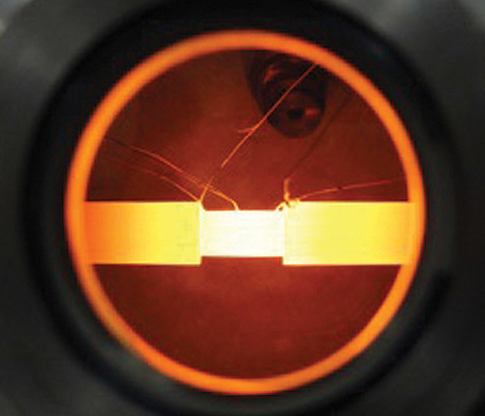

UPGRADE YOUR PROCESS SIMULATION CAPABILITIES
Speak with a Gleeble application specialist to identify the right system for your materials research, process development, or production challenges. Gain expert guidance on metal forming, casting, heat treatment, and welding simulation to improve accuracy, reduce trials, and accelerate development.

EVERY CRITICAL METALWORKING PROCESS — SIMULATED
From the liquid-to-solid transition during casting to the final microstructure after heat treatment, Gleeble covers the full metal manufacturing process chain.

Metal Forming
Hot & Warm Metal Forming Simulation - Reproduce multi-pass rolling, forging, extrusion, and tube-forming schedules with precise temperature–strain–strain-rate control. Generate flow stress data and identify hot-ductility windows before committing to a mill trial.
- Hot compression & torsion testing
- Multi-pass rolling schedule simulation
- Hot workability & flow stress characterization
- Interpass time & recrystallisation studies
- Superplastic forming analysis

Casting & Solidification
Casting & Solidification Process Simulation - Reproduce the exact thermal cycle of continuous casting, ingot casting, and directional solidification. Measure hot-tear susceptibility, mushy-zone ductility, and solidification shrinkage critical for yield improvement.
-
Continuous casting thermal profile reproduction
-
Hot-tear & hot-crack sensitivity testing
-
Mushy-zone mechanical property measurement
-
Dendrite coherency & permeability studies
-
Segregation and microstructure validation

Heat Treatment
Heat Treatment Simulation & CCT Generation - Precisely replicate annealing, quench-and-temper, solution treatment, and ageing cycles. Generate continuous cooling transformation (CCT) and time-temperature transformation (TTT) diagrams that feed directly into processing models.
- CCT & TTT diagram construction
- Dilatometry during heating & cooling
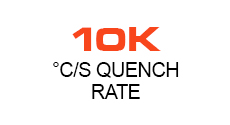
- Quench rate simulation up to 10,000 °C/s
- Intercritical annealing & austempering
- Precipitation kinetics & age-hardening curves

Welding & Joining
Weld HAZ Simulation & Joining Process Replication - Reproduce heat-affected zone (HAZ) thermal cycles from arc, laser, friction-stir, and electron-beam welding. Evaluate HAZ toughness, hydrogen cracking susceptibility, and liquation cracking without making a single weld.
-
Multi-pass HAZ thermal cycle reproduction
-
Liquation & solidification cracking evaluation
-
Post-weld heat treatment optimization
-
Hydrogen-induced cracking susceptibility
-
Gleeble-welded large specimens for Charpy & CTOD

Ultra-High Temperature
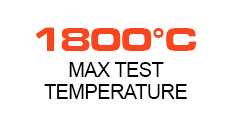
Ultra-High Temperature Materials Testing - Test superalloys, refractory metals, ceramics, and composites at temperatures up to 1800 °C under simultaneous mechanical loading. Characterize creep, oxidation interaction, and cyclic thermomechanical fatigue for aerospace and power-generation applications.
-
Testing to 1800 °C with resistive heating
-
Creep, stress-rupture & TMF testing
-
Vacuum & inert-gas atmosphere chambers
-
Superalloy & refractory metal characterization
-
TBC & ceramic coating thermal gradient tests

Physical Simulation
Physical Simulation as a Digital Twin Input - Gleeble data — flow curves, CCT diagrams, hot-ductility curves — forms the experimental foundation for FEA codes (DEFORM, Forge, Simufact) and ICME digital twin frameworks. Validate computational predictions against real physical simulation results.
-
Constitutive model data (Zener–Hollomon, JC, etc.)
-
Microstructure evolution model validation
-
ICME & Integrated Computational Materials Engineering
-
Machine-learning training dataset generation
-
ISO/ASTM compliant test protocols
WHY ENGINEERS CHOOSE GLEEBLE PHYSICAL SIMULATION
The Gleeble platform delivers a unique combination of ultra-fast resistive heating, real-time servo-hydraulic control, and simultaneous multi-channel measurement — all in a single, programmable system.
Ultra-Fast Resistive Heating
Achieve heating rates impossible with conventional furnace systems, replicating industrial thermal transients at laboratory scale.
Real-Time Servo-Hydraulic Control
Synchronized thermal and mechanical loading paths with closed-loop feedback for true process path fidelity.
QuikSim™ Software Integration
Every system ships with QuikSim™ for thermal–mechanical programming and data acquisition, with DIC, EBSD, and dilatometry module support.
ICME & Digital Twin Ready
Outputs integrate directly with DEFORM, Forge, and Simufact FEA codes, and serve as ML training datasets for next-generation digital twin frameworks.
ADVANCED GLEEBLE SYSTEMS FOR FULL PROCESS SIMULATION
Precision-controlled physical simulation systems designed to replicate real-world metal processing conditions—from casting and solidification to forming, welding, and heat treatment.
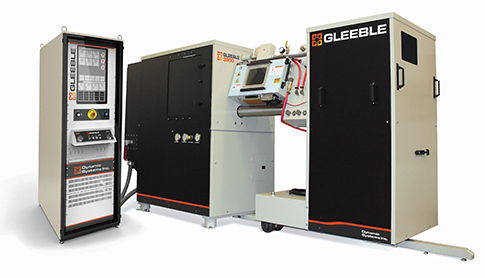
Gleeble 3500
The industry-proven platform for comprehensive process simulation, delivering accurate and repeatable thermo-mechanical data across a wide range of materials and applications.
- Enables full process simulation including casting, rolling, forging, and heat treatment
- Generates reliable flow stress data and hot-ductility results for process optimization
- Supports weld HAZ simulation, diffusion bonding, and continuous annealing studies
- Delivers precise thermal-mechanical control with heating and cooling rates up to 10,000 °C/s
- Ideal for materials development, research, and production troubleshooting
- Flexible system for both laboratory R&D and industrial process validation
> LEARN MORE
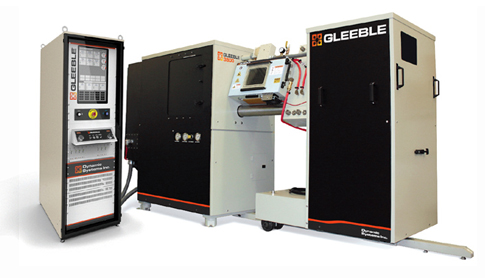
Gleeble 3800
Designed for advanced, high-force process simulation, enabling accurate replication of demanding metalworking conditions and large-scale deformation processes.
- Expands capabilities for multi-pass rolling, forging, and extrusion simulation
- Generates high-accuracy stress–strain and microstructure evolution data
- Ideal for solidification, casting simulation, and hot deformation studies
- Handles complex simulations with higher loads (up to 20 tons) and faster stroke rates
- Supports advanced process development, ICME modeling, and digital twin validation
- Modular system with Mobile Conversion Units (MCUs) for expanded simulation capabilities
> LEARN MORE
PUBLISHED RESEARCH
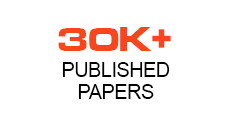
Over 30,000 Papers Built on Gleeble Data
The Gleeble is the world's most published thermo-mechanical simulation platform. Browse a selection of recent peer-reviewed work that relied on Gleeble physical simulation results.

EXPLORE THE FULL RESEARCH LIBRARY
Discover how leading researchers use Gleeble to generate trusted, high-impact materials data. Access the full library of peer-reviewed studies to inform your next breakthrough.

READY TO BRING PROCESS SIMULATION INTO YOUR LAB?
Whether you are developing a new metal alloy, optimizing a casting schedule, validating a heat treatment cycle, or generating constitutive data for a digital twin — a Gleeble application specialist will map the right system to your exact research or production challenge.