

GLEEBLE BEAM LINE SYSTEM
Real-Time In Situ Materials Science at the Synchrotron
The Beam Line Gleeble® unites world-class Gleeble physical simulation with high-flux synchrotron X-ray diffraction — enabling dynamic thermo-mechanical testing and in situ materials characterization no other platform can match.
A Gleeble Synchrotron System Built for Discovery
Materials research has always faced a fundamental challenge: how do you observe what is happening inside a material at the atomic scale while simultaneously subjecting it to the thermal and mechanical conditions that define its real-world behavior? Conventional test machines and standard X-ray labs cannot bridge this gap.
The Beam Line Gleeble Synchrotron System was engineered specifically for this purpose.
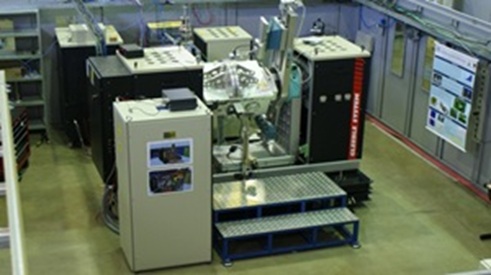
By integrating the precision thermo-mechanical control of a Gleeble simulator with the penetrating brightness of a synchrotron X-ray beam, researchers can perform in situ thermo-mechanical testing with synchrotron X-rays — watching phase transformations, residual stress evolution, oxidation, and corrosion unfold in real time, under real conditions, at the microstructural level.
The result is an unprecedented depth of Gleeble materials characterization: not a snapshot of a material after testing, but a live, continuously resolved picture of how structure responds to stress and temperature during the experiment itself.

READY TO BRING IN SITU SYNCHROTRON TESTING TO YOUR FACILITY?
Whether you are planning a new beam line experimental station, upgrading an existing facility, or evaluating the feasibility of Gleeble synchrotron integration for your research program, our specialist engineers are ready to help.
CORE FEAURES OF THE BEAM LINE GLEEBLE
Every element of the Beam Line Gleeble is purpose-designed for the unique demands of synchrotron beam line environments — combining precision, safety, and scientific rigor.

High-Power Resistive Heating & Precision Quench
Direct resistance heating delivers thermal rates from ambient to extreme temperatures with closed-loop thermocouple feedback, replicating industrial processing cycles with laboratory precision. Rapid quenching preserves in-process microstructures for post-test validation.

Synchrotron-Optimized Beam Line Load Frame
The load frame is geometrically designed to position the specimen at the exact focal point of the X-ray beam. Compact, low-profile construction minimizes beam attenuation and scattering while delivering full tensile and compressive force capability.

Simultaneous In Situ X-Ray Diffraction
High-flux synchrotron X-rays pass through the specimen continuously during thermo-mechanical loading. Fast detector acquisition captures diffraction patterns in milliseconds, resolving phase transformations, lattice strain, and texture evolution as they occur.

Remote Operation & Closed-Loop Digital Control
The control system is designed for full remote operation from outside the radiation work cell. Windows-based software with multi-processor architecture manages thermal profiles, mechanical loading sequences, and data acquisition — simultaneously and in real time.

Synchronized Multi-Channel Data Acquisition
Thermal, mechanical, and X-ray diffraction data streams are time-stamped and synchronized. Researchers capture correlations between applied conditions and microstructural response with sub-second temporal resolution across all channels.

Customizable Configuration for Any Beam Line
Geometry, X-ray window design, heating system, atmosphere control, and software interfaces can all be configured to integrate with the specific experimental station requirements of any synchrotron facility worldwide.

Wide Thermal & Mechanical Operating Range
The system accommodates the broad temperature and force ranges demanded by high-temperature materials testing — from sub-ambient through ultra-high temperature regimes — supporting research on structural alloys, ceramics, and functional materials.

Radiation Safety & Beam Line Integration Compliance
System design accounts for radiation shielding requirements, interlock integration, and safety protocols mandated by synchrotron facilities. Commissioning support ensures safe, compliant installation at any accredited beam line laboratory.

Atmosphere Control for Corrosion & Oxidation Studies
Controlled atmosphere options support in situ studies of corrosion, oxidation, and environmental effects at elevated temperatures — enabling research on materials exposed to aggressive service environments in energy, aerospace, and subsea applications.
FIRST BEAM LINE GLEEBLE IN THE WORLD:
Brazilian Synchrotron Light Laboratory (LNLS)
LNLS — Campinas, Brazil
Laboratório Nacional de Luz Síncrotron
Latin America's only synchrotron light source
Pioneering In Situ Thermo-Mechanical Research at a 3rd-Generation Synchrotron
The Brazilian Synchrotron Light Laboratory (LNLS) — a multidisciplinary national research facility in Campinas, Brazil, operated under CNPEM and housing the Sirius third-generation synchrotron — became the first institution in the world to operate a purpose-built Beam Line Gleeble system. The project was funded by Petrobras S.A., Brazil's national energy company, to support the safe and environmentally responsible exploitation of oil reserves in ultra-deep waters.
With the Beam Line Gleeble integrated into LNLS's experimental station, researchers can for the first time combine the dynamic thermo-mechanical capabilities of Gleeble physical simulation with high-flux synchrotron X-rays from the Sirius source. Initial research focuses on phase transformations in functional and structural materials, including corrosion-resistant and high-temperature alloys critical to Petrobras's subsea and offshore operations. The system also supports studies of diffusion-controlled and displacive martensitic and bainitic transformations in metallic alloys — delivering fundamental scientific data to face the engineering challenges of ultra-deepwater exploration.

EXPLORE THE NEXT GENERATION OF MATERIALS TESTING
Download the Gleeble Beam Line System brochure to read more about high-flux synchrotron X-ray diffraction in situ measurement technology.
FROM SYNCHROTRON SOURCE TO SCIENTIFIC INSIGHT
The Beam Line Gleeble integrates seamlessly into a synchrotron experimental station. Here is how a typical in situ thermo-mechanical experiment unfolds:
- Specimen Preparation & Mounting
- Specimens are prepared to beam-line-appropriate dimensions and mounted in the Gleeble load frame, positioned precisely at the X-ray beam focal point. Thermocouples and load sensors are attached for closed-loop control.
- Program Definition — Remote Console
- Operators define the thermo-mechanical cycle — heating rates, hold temperatures, loading forces, strain rates, and quench sequences — via the Windows-based software from outside the radiation enclosure.
- Simultaneous Thermal, Mechanical & X-Ray Data Capture
- As the Gleeble executes the programmed cycle, synchrotron X-rays continuously probe the specimen. Fast-acquisition detectors capture diffraction patterns in near-real time, while the Gleeble logs force, displacement, temperature, and strain.
- Analysis: Structure–Property Correlation
- Diffraction data is processed to reveal phase fractions, lattice parameters, residual stress, and texture. Combined with mechanical data, researchers build complete structure–property–process relationships unavailable through any other technique.

COMMON QUESTIONS
ANSWERED BY OUR ENGINEERS
Get answers to common questions about our high-flux synchrotron X-ray diffraction for thermo-mechanical testing and in situ materials characterization.
STILL HAVE QUESTIONS? CONTACT OUR TEAM
Let us know if you're ready for the industry's most advanced in situ thermo-mechanical testing with synchrotron X-rays.