



SICO TESTING FOR ADVANCED MATERIALS
The Gleeble System enables high-precision Strain Induced Crack Opening (SICO) testing under conditions that mirror your actual manufacturing process — not just a controlled laboratory environment. Configured specifically for your research objectives, the Gleeble delivers the thermal-mechanical fidelity that standard test frames cannot.
What Is SICO Testing?
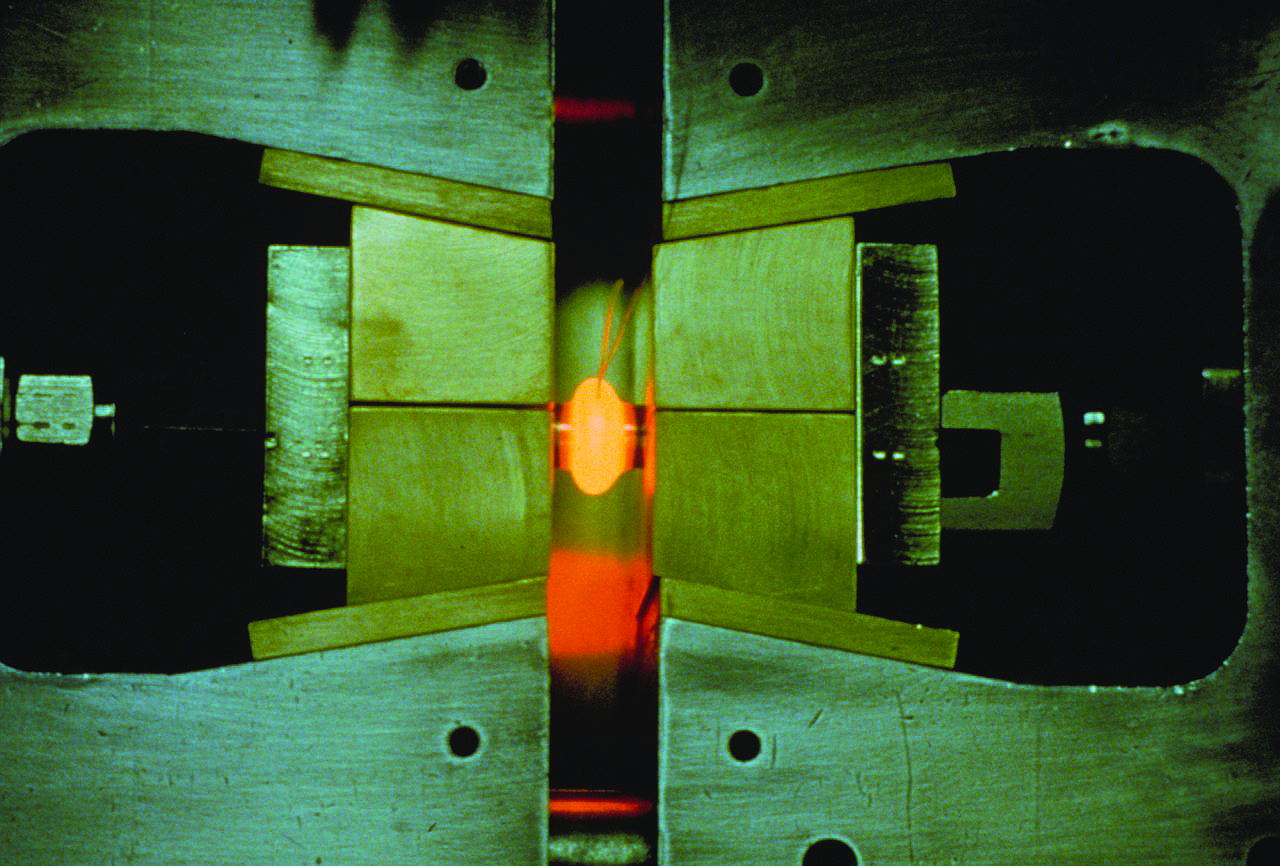
Strain Induced Crack Opening (SICO) testing is a Gleeble-exclusive thermo-mechanical test method designed to evaluate a material's susceptibility to hot cracking under realistic processing conditions. A specimen is heated to target temperatures within the material's solidification range or hot working regime, then subjected to controlled compressive deformation across varying strain rates — while the test system monitors continuously for crack initiation. The result is a map of the critical temperature, strain, and strain rate combinations at which cracking begins.
Unlike conventional approaches that isolate individual variables, SICO replicates the complex thermo-mechanical stress state a material experiences during industrial forging, forming, and welding — where temperature, strain, and strain rate interact simultaneously to determine whether cracking occurs. This interaction cannot be captured by thermal analysis or static mechanical testing alone. The SICO test was developed specifically for the Gleeble platform because only a system with simultaneous high-rate thermal control and servo-hydraulic mechanical control can reproduce these coupled conditions with the precision required for meaningful crack initiation data.
Because SICO testing is performed on small specimens under fully controlled laboratory conditions, engineers can screen multiple alloy compositions, process parameters, or heat treatment conditions in days — replacing weeks or months of full-scale production trials with quantitative, reproducible laboratory data.
Pain Points We Solve
- Hot cracking during forging, forming, or welding with no quantitative understanding of the conditions that trigger it — SICO testing maps the precise temperature-strain-strain rate combinations where crack initiation occurs
- Process development relying on full-scale production trials to define safe operating windows — the Gleeble generates this data from small specimens in a fraction of the time and cost
- Alloy selection based on composition alone without processability data — SICO testing quantifies hot cracking resistance across alloy variations so composition decisions reflect both performance and manufacturability
- Weld procedure qualification without insight into base metal cracking response — SICO characterizes how materials respond to the thermal cycles and restraint conditions of specific joint configurations before procedure trials begin
- Field failures with suspected hot cracking root causes that cannot be confirmed — the Gleeble reproduces the exact thermo-mechanical history of a failure event to validate root cause hypotheses and corrective actions
Comprehensive SICO Property Characterization
This dataset captures material hot cracking behavior across the full range of process-relevant temperature, strain, and strain rate conditions. Hot cracking susceptibility windows define the precise thermo-mechanical combinations that trigger crack initiation, enabling process parameters to be designed around critical zones rather than discovered through production failures. Safe operating windows for forging temperatures, strain rates, and deformation sequences are established directly from SICO data, replacing trial-and-error process development with quantitative boundary conditions.
Alloy composition effects on hot cracking resistance — including the influence of residual elements, microalloying additions, and solidification range on crack susceptibility — are quantified to guide alloy selection and development toward compositions that balance mechanical performance with processability. Prior heat treatment effects on cracking behavior characterize how thermal processing history influences susceptibility, enabling optimization of pre-process treatment sequences. Weld procedure development data, derived from SICO testing under welding-representative thermal cycles and restraint conditions, supports procedure qualification and filler metal selection across joint configurations. Failure analysis correlation datasets, generated by reproducing field failure conditions in the laboratory, confirm root cause hypotheses and validate corrective actions before production implementation.
The Gleeble Advantage: SICO Testing
SICO testing is not available on conventional test platforms. The simultaneous requirements of rapid high-rate heating, precise temperature control through the solidification range, and closed-loop servo-hydraulic compression at controlled strain rates cannot be met by furnace-equipped load frames or standard high-temperature testing machines.
The Gleeble Physical Simulation System is the only commercial platform on which SICO testing can be performed. Developed specifically for the Gleeble, the SICO method represents one configurable measurement within a broader physical simulation capability that replicates the complete industrial process sequence from casting through final fabrication.
- The only commercial system that combines direct resistance heating, closed-loop servo-hydraulic mechanical control, and dilatometry in a single integrated platform
- Thermal control accuracy of ±0.1°C throughout the specimen gauge length, enabling reproducible crack initiation measurements across test campaigns and between laboratories
- SICO is a Gleeble-exclusive test method — it cannot be replicated on any other commercial testing platform
- Validated against industrial process conditions across steel, aluminum, titanium, nickel, copper, and refractory alloy systems by hundreds of global research institutions
- Supports SICO, nil strength, hot ductility, tensile, compression, weld simulation, HAZ simulation, continuous cooling transformation (CCT), isothermal transformation (TTT), and more — all on one platform
- Data outputs are directly compatible with leading FEM packages including DEFORM, Simufact, Forge, and ABAQUS for constitutive model development
Published Research Using Gleeble SICO Testing
Explore a selection of published studies that demonstrate how Gleeble SICO testing is used to evaluate a material’s susceptibility to cracking under combined thermal and mechanical strain. These real-world applications highlight the system’s role in understanding hot ductility behavior, supporting process development, and generating reliable, high-quality data across a range of industries
- Testing for Susceptibility to Hot Cracking on Gleeble™ Physical Simulator S.T. Mandziej In: T. Böllinghaus, H. Herold (eds), Hot Cracking Phenomena in Welds. Springer, Berlin, Heidelberg, 2005. DOI: 10.1007/3-540-27460-X_18
- Assessment of technological plasticity of high-Mn steels in SICO test Gabriela Fojt-Dymara, Marek Opiela, Barbara Grzegorczyk & Adam Grajcar
- Testing for Susceptibility to Hot Cracking on Gleeble™ 3500 Physical Simulator Alsalamah Bassel, László Kuzsella, Zsolt Lukács
- Crack Appearance in Hot Rolled Billets S.T. Mandziej & G. Krallics
- Mitigation of Corner Cracking in Continuously Cast Steel Slabs Through Strain Induced Crack Opening Test Pranav Kumar Tripathi, D. Satish Kumar, T. Rajendra & S. C. Vishwanath

READY TO OPTIMIZE YOUR MATERIALS TESTING?
Discover how this unique Gleeble test can transform your laboratory testing into real-world manufacturing solutions. Our applications engineers are ready to discuss your specific testing requirements.