

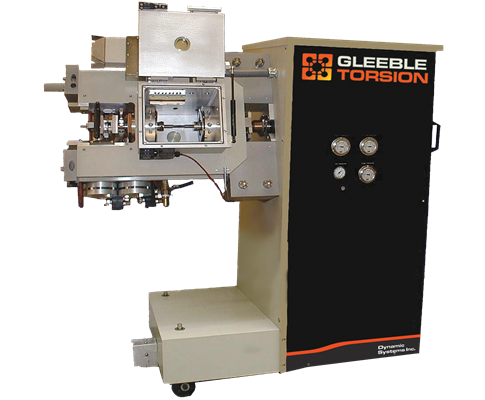
GLEEBLE HOT TORSION MCU
Advanced Hot Torsion Testing with Direct Resistance Heating for High-Temperature Materials Characterization
The Gleeble Hot Torsion Mobile Conversion Unit® delivers unparalleled precision in torsion testing equipment, combining rapid thermal response, high strain rate torsion testing capabilities, and in situ quenching for comprehensive thermo-mechanical testing of metals and advanced materials.
Precision Torsion Testing for Metal Forming and Materials Science
The Gleeble Hot Torsion Mobile Conversion Unit represents the pinnacle of high-temperature torsion testing equipment, specifically engineered for materials scientists, metallurgists, and R&D professionals in the metals processing industry. This hot torsion system addresses critical challenges in simulating real-world metal forming processes, including hot rolling, forging, and extrusion.
Traditional torsion testing methods struggle with thermal lag, limited heating rates, and inability to capture true high-strain-rate behavior.
Our resistance heating torsion solution eliminates these constraints through direct specimen heating, achieving unprecedented thermal precision and control. This enables accurate simulation of industrial forming conditions and reliable characterization of flow stress, dynamic recrystallization, and grain evolution in steels, aluminum alloys, titanium, and superalloys.
Whether you're optimizing steel rolling schedules, developing new alloy compositions, or validating constitutive models for metal forming simulations, the Gleeble Hot Torsion MCU delivers the data accuracy and process flexibility your research demands.

READY TO ADVANCE YOUR MATERIALS TESTING CAPABILITIES?
Contact our applications engineering team to discuss your specific thermo-mechanical testing requirements and discover how the Gleeble Hot Torsion MCU can accelerate your research and development programs.
KEY ADVANTAGES
- Direct resistance heating enables heating rates up to 500°C/s with precise temperature control (±1°C)
- Combined tension and torsion testing capabilities with independent axial load control up to 500 kgf
- Rapid quench torsion testing system with in situ quenching to preserve microstructure at any deformation stage
- High strain rate capabilities from 2 rpm to 1,500 rpm with 0.1° angular resolution
- Vacuum atmosphere torsion testing prevents oxidation during high-temperature characterization
- Computer-controlled revolution management for complex thermo-mechanical testing schedules
- Seamless integration with existing Gleeble systems for comprehensive materials testing
CORE FEATURES & CAPABILITIES
Industry-leading technology designed specifically for high-temperature materials characterization and metal forming simulation.

Direct Resistance Heating Technology
Achieve ultra-rapid heating rates up to 500°C/s with direct current flow through specimens. This eliminates thermal lag inherent in furnace-based systems, enabling accurate simulation of rapid industrial heating cycles and precise control of thermal history during deformation.

HSR - High Strain Rate Testing
Hydraulic servo actuator delivers controlled torsion from 2 rpm to 1,500 rpm with exceptional acceleration (0 to 1,500 rpm in 7 ms). Capture flow stress behavior across the full spectrum of industrial metal forming conditions from slow forging to high-speed rolling operations.

ISQ - In Situ Quenching System
Integrated rapid quench capability allows instant specimen cooling at any point during the test sequence. Preserve deformed microstructure for detailed metallographic analysis, correlating mechanical response with grain structure evolution, recrystallization, and phase transformations.

CTT - Combined Tension-Torsion Testing
Independently controlled axial loading (500 kgf tension/compression) combined with torsion enables complex stress state simulation. Model industrial processes involving simultaneous shear and normal stresses, such as rolling with reduction or extrusion with back pressure.

VAC - Vacuum & Controlled Atmosphere
Test chamber accommodates vacuum or inert gas atmospheres, preventing surface oxidation during high-temperature testing of reactive materials. Critical for accurate characterization of titanium alloys, superalloys, and advanced high-strength steels.

CMP - Computer-Controlled Precision
Advanced digital control system manages complex multi-stage thermo-mechanical schedules with 0.1° angular resolution. Program sophisticated test sequences including multi-pass deformation, inter-pass times, and strain rate changes to replicate actual production schedules.

MAX - Maximum Torque Capacity
Standard 50 Nm torque cell handles most materials testing requirements, with optional 100 Nm cell available for high-strength alloys and large specimen geometries. Flexible torque measurement ensures optimal resolution across your material portfolio.

TMP - Thermo-mechanical Processing Simulation
Accurately reproduce industrial thermo-mechanical processing routes including controlled rolling, thermo-mechanical controlled processing (TMCP), and recrystallization-controlled rolling. Generate data for constitutive model development and process optimization.

MCU - Mobile Conversion Unit Design
Modular MCU architecture integrates seamlessly with your existing Gleeble system infrastructure. Rapidly switch between tension, compression, and torsion testing modes to maximize laboratory efficiency and equipment utilization.

EXPLORE THE NEXT GENERATION OF MATERIALS TESTING
Download the Gleeble Hot Torsion MCU System brochure to read more about our unparalleled precision torsion testing equipment.
Technical Specifications
Engineered for precision, reliability, and comprehensive materials characterization
|
Specifications |
Gleeble Hot Torsion MCU |
| System Features | |
|
Motor Drive |
Hydraulic Servo Actuator |
|
Revolution Control |
Computer-controlled |
| System Tolerances | |
|
Maximum Thrust in Tension |
500 kgf (1,102.31 lbf) 4.9 kN |
|
Maximum Thrust in Compression |
500 kgf (1,102.31 lbf) 4.9 kN |
|
Maximum Torque |
Maximum Torque 50 Nm (36.85 lbf/ft) with standard torque cell
100 Nm (+ 73.75 lbf/ft) with optional torque cell |
|
Angular Resolution |
±0.1 degree |
|
Maximum Number of Revolutions |
90 |
|
Minimum Control Speed |
2 rpm |
|
Maximum Control Speed |
1,500 rpm for 1 second |
|
Maximum Acceleration |
0 - 1,500 rpm in 7 ms |
|
Maximum Deceleration |
1,500 - 0 rpm in 7 ms |

COMMON QUESTIONS
ANSWERED BY OUR ENGINEERS
Get answers to common questions about our resistance heating torsion solution.
STILL HAVE QUESTIONS? CONTACT OUR TEAM
Let us know if you're ready for the unparalleled Gleeble Hot Torsion Mobile Conversion Unit.