


STRESS RELAXATION TESTING FOR MODERN MATERIALS
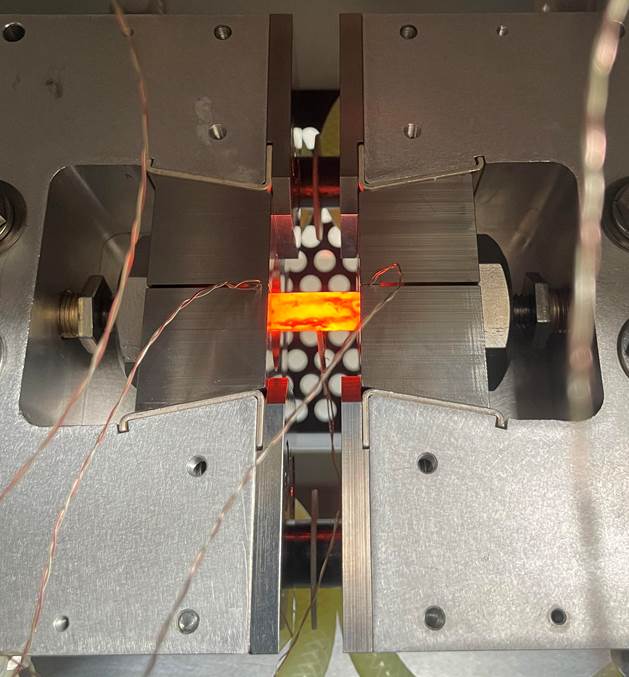
Gleeble Systems enable high-precision stress relaxation testing under conditions that mirror your actual manufacturing process — not just a controlled laboratory environment. Configured specifically for your research objectives, the Gleeble delivers the thermal-mechanical fidelity that standard test frames cannot.
What Are Stress Relaxation Studies?
Stress relaxation testing measures how internal stresses within a material decrease over time when held at constant strain. As a specimen is deformed to a fixed displacement and held, the load required to maintain that displacement is recorded continuously — producing a stress-time curve that characterizes the rate and extent of stress decay under sustained deformation.
This time-dependent behavior becomes particularly significant at elevated temperatures, where thermally activated mechanisms including creep, recovery, and microstructural evolution accelerate stress redistribution. A material that appears stable under short-duration loading may shed a significant fraction of its stress over hours or days at service temperature — with direct consequences for joint integrity, dimensional stability, and fatigue life in precision components. For engineers working with superalloys in turbine applications, stainless steels in nuclear components, or any material where sustained high-temperature loading is a design condition, stress relaxation data is not supplementary — it is the measurement that validates long-term performance predictions.
The Gleeble couples stress relaxation measurement with precise thermal simulation, enabling testing across the full range of service-relevant temperatures and thermal histories rather than at arbitrary isothermal conditions that may not reflect the microstructural state a component actually reaches in service
Pain Points We Solve
- Long-term service performance predictions built on short-duration or ambient test data — the Gleeble generates stress relaxation data across the full temperature and time range your application demands
- Residual stress redistribution in welded assemblies or manufactured components that cannot be predicted without relaxation data — the Gleeble quantifies how process-induced stresses will evolve under service conditions
- Constitutive models for creep and relaxation built on incomplete or poorly controlled datasets — the Gleeble provides the thermally coupled, precisely controlled stress-time data needed for high-fidelity model calibration
- Alloy development programs slowed by the time and cost of long-duration relaxation testing — the Gleeble enables rapid screening of multiple compositions or heat treatment conditions from small specimens
- Stress relief cracking susceptibility in weld HAZ that cannot be evaluated without thermally representative testing — the Gleeble replicates the exact thermal cycle and stress state of the affected zone
Comprehensive Stress Relaxation Property Characterization
This type of data captures time-dependent stress decay behavior across the full range of temperature, strain, and thermal history conditions relevant to material service and processing. Stress relaxation curves as a function of temperature and initial strain level provide the foundational data for constitutive model development — including Norton, Garofalo, and physically based creep-relaxation formulations — for use in structural life prediction and FEM simulation. Creep resistance characterization quantifies time-dependent deformation resistance for components operating under sustained loads in turbine, power generation, and nuclear environments.
Residual stress redistribution data models how manufacturing-induced stresses evolve under service conditions, informing dimensional stability predictions and fatigue life assessments for precision components and welded assemblies. Microstructural evolution correlation — linking relaxation behavior to recovery, recrystallization, and precipitation kinetics — supports heat treatment optimization for targeted mechanical properties. Stress relief cracking susceptibility in weld heat-affected zones is evaluated by replicating the exact thermal cycle and stress state of the HAZ under controlled laboratory conditions. Alloy composition and heat treatment effects on relaxation behavior are quantified from small specimen volumes, enabling rapid screening of experimental compositions before commitment to full-scale qualification programs.
The Gleeble Advantage: Stress Relaxation Testing
Stress relaxation testing at elevated temperature requires stable load control, precise and uniform specimen heating, and the ability to maintain exact temperature and strain conditions over extended hold periods. Conventional furnace-equipped test frames can approximate isothermal relaxation conditions, but cannot reproduce the thermal transients of welding or processing cycles that determine the microstructural state — and therefore the relaxation response — of a material at the start of the hold.
The Gleeble Physical Simulation System is not simply a high-temperature relaxation tester. It is a complete physical simulation platform that replicates the industrial process sequence a material experiences before and during service, with stress relaxation testing representing one configurable measurement within that broader simulation capability.
- The only commercial system that combines direct resistance heating, closed-loop servo-hydraulic mechanical control, and dilatometry in a single integrated platform
- Thermal control accuracy of ±0.1°C throughout the specimen gauge length, enabling reproducible relaxation measurements across test campaigns and between laboratories
- Validated against industrial process conditions across steel, aluminum, titanium, nickel, copper, and refractory alloy systems by hundreds of global research institutions
- Supports stress relaxation, creep, tensile, compression, weld simulation, HAZ simulation, continuous cooling transformation (CCT), isothermal transformation (TTT), and more — all on one platform
- Data outputs are directly compatible with leading FEM packages including DEFORM, Simufact, Forge, and ABAQUS for constitutive model and life prediction development
- Decades of peer-reviewed publications and industry case studies validating Gleeble physical simulation data against full-scale industrial trials
Published Research Using Gleeble Stress Relaxation Capabilities
Explore a selection of published studies that demonstrate how Gleeble stress relaxation testing is used to evaluate how materials relieve stress under controlled thermal and mechanical conditions over time. These real-world applications highlight the system’s role in understanding time-dependent deformation behavior, supporting process optimization, and generating reliable, high-quality data across a range of industries.
- Comparison of Stress Relaxation Cracking Susceptibility of Austenitic Stainless Steels H.S. LEE, B.S. KIM, AND S. I. HONG
- Thermomechanical characterization of 22M nB5 steels with special emphasis on stress relaxation and creep behavior Rohith Uppaluri , Dirk Helm
- Stress relaxation cracking susceptibility evaluation in 347H stainless steel welds Timothy Pickle, Yu Hong, Judith Vidal, Chad Augustine & Zhenzhen Yu
- Time-dependent springback prediction with stress relaxation effect for non-isothermal hot stamping of titanium alloy sheets Yuan Chen, Guofeng Han, Shuhui Li, Yongfeng Li, Zhiqiang Li & Zhongqin Lin

READY TO ADVANCE YOUR STRESS RELAXATION TESTING CAPABILITIES?
Discover how a custom-configured Gleeble system can transform your materials testing program. Our application engineers are ready to discuss your specific requirements and demonstrate how physical simulation delivers laboratory results that translate directly to real-world performance.