

INDUCTION HEATING SYSTEM
Expand What Your Gleeble Can Do
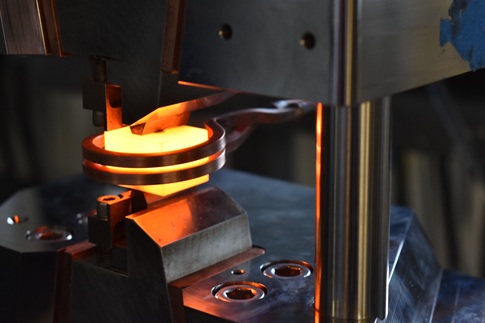
The Gleeble IHS (Induction Heating System) gives materials testing labs a powerful alternative heating method — fully integrated with your existing Gleeble 3500 or 3800 system. Achieve uniform temperature profiles across non-conductive specimens and anvil setups that direct resistance heating alone cannot reach.
What Is the Gleeble Induction Heating System?
Gleeble systems have long been the standard for thermomechanical physical simulation, relying on direct resistance heating to deliver extremely fast, uniform, and responsive heating — with rates up to 10,000 °C/second. That capability remains fully intact with the HIS upgrade.
The Gleeble Induction Heating System® (IHS) is a fully integrated upgrade developed in partnership with a leading induction heating supplier. It adds induction-based heating as a selectable alternative — or complement — to resistance heating on the same Gleeble platform. Each test can independently use either method, selected via the Gleeble software interface.
The IHS is vacuum-rated, rear-mounted, water-cooled, and powered directly from the Gleeble load unit, sharing the existing Gleeble cooling loop with no separate utility infrastructure required.
This upgrade is especially valuable when testing requires thermally non-conductive or electrically non-conductive anvils — situations common in uniaxial compression testing (flow stress), plane strain compression, and specialized thermomechanical simulation research where anvil-to-specimen electrical contact must be avoided.
Technology Explained
Induction + Resistance Heating on One System
One of the most common questions from Gleeble users is whether induction and resistance heating can coexist on the same system. The answer is yes. The IHS is fully integrated so both heating methods are available simultaneously, and the operator selects which to use for each individual test.
- Induction Heating
- Non-conductive setups
- Uniform cross-section heating
- Resistance Heating
- Fastest rates
- Standard specimen geometries
Both methods selectable per test via Gleeble software

READY TO UPGRADE YOUR GLEEBLE SYSTEM WITH INDUCTION HEATING?
Contact the Dynamic Systems Inc. team to discuss the Gleeble Induction Heating System (IHS) upgrade, confirm compatibility with your current Gleeble configuration, and receive a customized quotation. Our applications engineers can help you determine which coil geometries and anvil materials are best suited for your specific testing program.
CORE CAPABILITIES
Why Upgrade to the Induction System?
Non-Conductive Anvil Flexibility
Induction heating removes the electrical path requirement between specimen and anvils. Use thermally and electrically non-conductive anvil materials to maximize temperature uniformity from face to face in compression testing.
Per-Test Heating Mode Selection
The operator selects induction or resistance heating for each individual test via the standard Gleeble software interface. No hardware reconfiguration is needed between tests, preserving lab throughput and workflow efficiency.
Magnetic Concentrators for Targeted Heating
Magnetic concentrators direct electromagnetic fields to specific regions of the specimen, enabling efficient and precisely localized energy delivery — critical for testing bi-metallic, non-symmetrical, or geometrically unique samples.
3-Axis Coil Adjustability
Induction coils can be adjusted along all three axes from the workhead unit, enabling precise positioning for different specimen geometries and test types — and significantly reducing new test setup time.
Versatile Coil Library
Multiple coil geometries are available to support different specimen sizes and test configurations. The supply includes a standard test coil and a large calibration coil, with additional geometries available to customize the IHS for your research program.
Preserved Direct Resistance Heating Performance
The Induction Heating System upgrade does not compromise the Gleeble's industry-leading resistance heating performance. Rates up to 10,000 °C/second remain available, giving researchers the full spectrum of thermal processing capability.
Atmosphere Testing: Air, Vacuum & Inert Gas
The vacuum-rated IHS workhead supports testing in air, vacuum, or inert gas environments, enabling oxidation-sensitive materials research and specialized thermomechanical simulation protocols that require controlled atmospheres.
Advanced Quench System
An all-new quench spray system expands cooling options beyond the standard resistance-heating setup, supporting quench media including air, water, mist, and inert gas for precise post-deformation thermal processing simulation.
Same Thermocouple Measurement
Temperature measurement with the IHS uses the same thermocouple configuration as the standard Gleeble direct resistance heating system, ensuring data consistency across heating methods and simplifying test procedure development.
What Testing Applications Benefit Most from Induction Heating on a Gleeble System?
The Gleeble IHS is designed for applications where resistance heating presents physical or experimental constraints. The following test types are where induction heating delivers the greatest research advantage:

Uniaxial Compression Testing (Flow Stress)
Induction heating is ideally suited for flow stress testing because it generates a uniform temperature profile across the full specimen cross-section — from anvil contact face to face. This eliminates the thermal gradient introduced when electrical current must pass through the specimen and into conductive anvils, enabling more accurate constitutive behavior characterization.
Non-conductive anvils and lubricants can be used freely, removing limitations on anvil material selection and enabling the use of high-performance ceramic anvil systems

Plane Strain Compression Testing
Plane strain compression — used to study rolling deformation behavior — benefits significantly from induction heating. Electrically non-conductive tooling and die materials can be employed without compromising the thermal profile, and the 3-axis coil positioning system allows precise targeting of the deformation zone for improved temperature control.

Tensile Testing of Specialty Materials
Tensile testing of electrically resistive, non-homogeneous, or bi-metallic specimens — which may exhibit inconsistent heating under direct resistance — benefits from the electromagnetically driven uniform heating of induction. Magnetic concentrators further direct energy to the gauge section, minimizing thermal gradients across the specimen.

Heat Treatment & Annealing Simulation
Controlled heat treatment cycles — including austenitizing, normalizing, and annealing — can be performed with the IHS, with precise temperature control via the existing Gleeble thermocouple feedback loop. The ability to test in vacuum or inert gas atmospheres makes the IHS ideal for oxidation-sensitive alloys including titanium, nickel superalloys, and advanced high-strength steels.

Bi-Metallic & Non-Symmetrical Specimens
Custom induction coil designs can accommodate non-standard specimen geometries that are difficult to heat uniformly with resistance heating. Induction enables researchers to study welded assemblies, clad materials, and dissimilar-metal joints under controlled thermomechanical conditions without compromising the electrical circuit integrity of the Gleeble's measurement systems.

High-Temperature Materials Research
For advanced materials testing at extreme temperatures — including refractory metals, ceramics, and next-generation aerospace alloys — induction heating provides an efficient, contactless energy delivery mechanism. Combined with the Gleeble's precision mechanical testing capability, the IHS enables comprehensive thermo-mechanical characterization of materials at elevated and ultra-high temperatures.

EXPLORE THE NEXT GENERATION OF MATERIALS TESTING
Download the Gleeble Systems brochure to accelerate development and optimize your processes. Get the insights you need to improve quality and move faster.

CURIOUS ABOUT THE GLEEBLE INDUCTION HEATING SYSTEM?
From system capabilities and testing applications to setup, operation, and support—find clear, expert answers to help you move forward with confidence. Browse the FAQ to get the insights you need, fast.
STILL HAVE QUESTIONS? CONTACT OUR TEAM
We can help select the best Induction Heating System for your needs.