


ENERGY INDUSTRY SOLUTIONS
Advanced Materials Testing for Extreme Environments
From subsea pipelines to nuclear reactor cores, offshore wind structures to emerging hydrogen infrastructure; Gleeble systems give energy materials engineers the data they need to qualify faster, fail less, and innovate with confidence.
Energy-Grade Materials Demand Uncompromising Qualification
The energy industry operates at the edges of what materials can endure — extreme pressures, corrosive chemistries, radiation fields, cyclic fatigue loads, and temperatures that challenge the limits of metallurgy. Qualification failures don't just cost money; they cost lives, uptime, and regulatory standing.
Gleeble thermo-mechanical simulation systems allow materials engineers, metallurgists, and R&D teams to reproduce, precisely replicate, and deeply analyze the real-world thermal and mechanical conditions that energy materials will face — in controlled laboratory conditions, at a fraction of the cost and time of field testing or full-scale trials.
Whether you're qualifying a corrosion-resistant alloy for a deepwater production system, developing radiation-resistant structural materials for a next-generation reactor, validating steel for a 15 MW offshore wind monopile, or characterizing hydrogen embrittlement behavior in high-pressure storage, the Gleeble gives your team a decisive edge in speed, accuracy, and scientific depth.

TALK TO AN ENERGY MATERIALS MATERIALS EXPERT
Ready to validate critical components and accelerate certification? Contact our team to discuss your automotive testing and simulation needs.
CORE CAPABILITIES
What Gleeble Systems Deliver for Energy Materials Testing
Gleeble systems combine resistive heating, servo-hydraulic loading, and advanced thermal control into a single, highly programmable testing platform. For energy sector applications, this unlocks a range of capabilities no standalone testing solution can match.

Extreme Thermo-Mechanical Simulation
Gleeble systems precisely replicate real-world thermal and mechanical conditions through direct resistive heating and synchronized load control, enabling unmatched fidelity in high-temperature materials testing.
-
Ultra-High Temperature Testing
-
Precise Thermal Cycle Simulation
-
Simultaneous Thermo-Mechanical Loading
Advanced Material Behavior Characterization
Gleeble generates high-accuracy material response data across extreme temperatures, strain rates, and environments, providing critical insight into performance limits and deformation behavior.
-
Hot Deformation & Flow Stress Characterization
-
Fatigue & Cyclic Loading Simulation
-
Dilatometry & Phase Transformation Analysis
-
Corrosion & Environment-Assisted Cracking
Process Simulation & Digital Integration
Gleeble bridges physical testing and computational modeling by replicating industrial processes and producing validated data for simulation, accelerating materials and process development.
-
Weld Simulation & HAZ Analysis
-
Materials Database & Process Modeling Integration
ENERGY AND POWER MATERIALS TESTING SYSTEMS
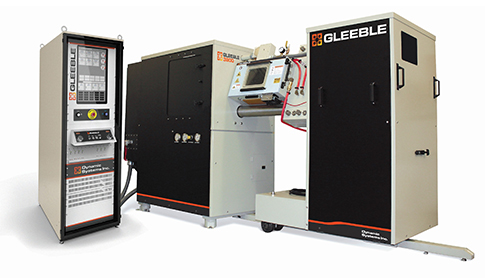
Gleeble 3500
A proven aerospace materials testing system for thermal-mechanical simulation, alloy characterization, and manufacturing process optimization.
- High-precision thermal-mechanical testing for titanium alloys, superalloys, and advanced aerospace materials
- Generates critical data for aerospace forming, forging, and rolling process optimization
- Enables accurate flow stress characterization across wide temperature and strain-rate ranges
- Supports multi-stage deformation simulation to replicate real-world aerospace manufacturing conditions
- Ideal for aerospace materials research, lightweight structure development, and process validation
> LEARN MORE
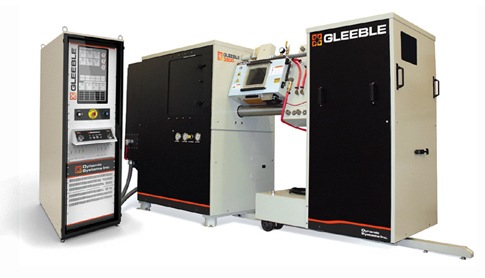
Gleeble 3800
An advanced thermal-mechanical simulation system for aerospace welding, high-temperature materials testing, and extreme-condition validation.
- Enhanced force capacity for complex aerospace thermal-mechanical simulation
- Industry-leading capabilities for aerospace welding simulation and heat-affected zone (HAZ) analysis
- Replicates extreme thermal cycles for superalloy testing and high-temperature materials validation
- Delivers precise control for critical aerospace and defense materials testing applications
- Optimized for turbine engine materials, weld validation, and failure prevention
> LEARN MORE
The Gleeble Advantage: Advanced Simulation for Accelerated Material Qualification
Gleeble transforms material development from a sequential, trial-and-error process into a fast, data-driven workflow by bringing real-world thermo-mechanical conditions into the lab at the earliest stages. Teams can generate critical material intelligence before scale-up, using high-fidelity physical simulation to validate computational models, eliminate weak candidates, and focus only on viable alloy designs. Because Gleeble replicates true service and processing conditions — not approximations — the resulting data is trusted for predicting in-field performance and guiding process decisions with confidence.
This same fidelity and data quality streamline the path to qualification and deployment. Gleeble methodologies are widely recognized within ASTM, ISO, NACE, and API frameworks, enabling teams to build a credible, traceable evidence base from the outset. By identifying optimal processing windows, assessing weldability, and predicting microstructural outcomes early, organizations can dramatically reduce reliance on expensive full-scale trials and compress qualification timelines from years to weeks.
The Gleeble occupies a unique position in the materials R&D toolkit: it bridges the gap between purely computational materials modeling and the irreplaceable reality of physical testing. For energy sector applications — where computational models are still maturing and physical field data is expensive to acquire — the Gleeble's physical simulation capability is the fastest credible path to materials qualification.
Teams using Gleeble simulation consistently report compressing alloy qualification cycles significantly with documented reductions in the number of full-scale qualification test campaigns required before regulatory submission.
Proven Solutions for The Energy Industry
Oil & Gas
Qualifying materials for oil and gas applications, from upstream wells to downstream pipelines, requires the most rigorous testing for high-pressure, high-temperature, and corrosive environments. Subsea and downhole conditions can accelerate material degradation, so corrosion-resistant alloys like duplex stainless steels, Inconel, and titanium must demonstrate resistance to cracking and corrosion before deployment. Pipeline steels and tubing require full weldability assessments, including toughness in cold conditions, while risers and flowlines need fatigue testing under complex loading cycles.
Ultra-deep applications demand materials that maintain strength and integrity under extreme pressures. Gleeble systems help meet these challenges by simulating realistic thermal and mechanical cycles to study material behavior and stability, defining safe welding processes to reduce cracking, producing large numbers of weld zone specimens for toughness and hardness testing, measuring deformation and flow behavior for process modeling, and evaluating corrosion and cracking resistance under controlled conditions.
Nuclear
Developing materials for nuclear energy—both fission and fusion—requires testing capabilities far beyond standard furnaces or mechanical test frames. Reactor structural materials, such as pressure vessel steels and internal components, must maintain mechanical stability over decades of high-temperature service. Fuel cladding materials, including zirconium alloys and advanced composites, need characterization under extreme temperature transients that simulate accident conditions. Advanced reactor designs, small modular reactors, and fusion systems demand alloys qualified for high-temperature creep, fatigue, and plasma-facing conditions.
Gleeble systems address these challenges by performing ultra-high temperature testing on irradiated and unirradiated specimens to generate comparable datasets, simulating accident thermal transients with precise control of temperature and strain, measuring creep and deformation in advanced alloys under realistic conditions, optimizing thermo-mechanical processing for radiation-resistant steels, and producing weld zone specimens for post-irradiation examination, maximizing the value of limited material inventories.
Wind & Solar
As wind turbines grow taller and offshore foundations larger, and as solar installations operate in increasingly demanding climates, advanced materials testing becomes a key competitive advantage. Offshore monopiles and jackets require very high-strength steels that maintain toughness in thick sections, while turbine gearboxes, bearings, and tower welds must withstand complex fatigue and variable loads. Blade roots, hub structures, and transition pieces experience combined bending and torsional stresses in seawater environments, and concentrated solar power systems rely on high-temperature alloys for heat receivers and thermal storage components.
Gleeble systems meet these challenges by characterizing the thermo-mechanical behavior of structural steels for thick-section offshore applications, generating comprehensive fatigue data for high-performance alloys under realistic conditions, reproducing multi-pass weld thermal cycles for full weld zone evaluation, assessing hydrogen-assisted fatigue susceptibility in offshore steels, and testing high-temperature alloys for creep and oxidation resistance in solar power applications.
Energy Industry Research Papers Using Gleeble
Gleeble systems have contributed to thousands of peer-reviewed publications across the energy field.
- Research papers about different energy -related things/companies
- Research papers about different energy-related things/companies
- Research papers about different energy-related things/companies
 Ready to Accelerate Your Energy Materials Program?
Whether you are qualifying materials for a new deepwater field, advancing a next-generation reactor program, or pushing the limits of offshore wind structural steel— Gleeble's team of applications engineers is ready to help you design the right simulation protocol for your materials challenge.