


ADVANCES DUCTILITY TESTING FOR MODERN MATERIALS
The Gleeble System enables ductility testing under conditions that closely replicate real-world manufacturing processes—not just simplified laboratory setups. Tailored to your specific research goals, it delivers precise thermal-mechanical control and realism that conventional test frames cannot match, helping you generate data that reflects true material performance.
What Is Ductility Testing?
Ductility testing measures a material's ability to undergo plastic deformation under tensile stress before fracture. As a specimen is loaded to failure, the resulting reduction in area and elongation at fracture are recorded — quantifying how much a material can deform before breaking and providing direct insight into cracking susceptibility under real processing conditions.
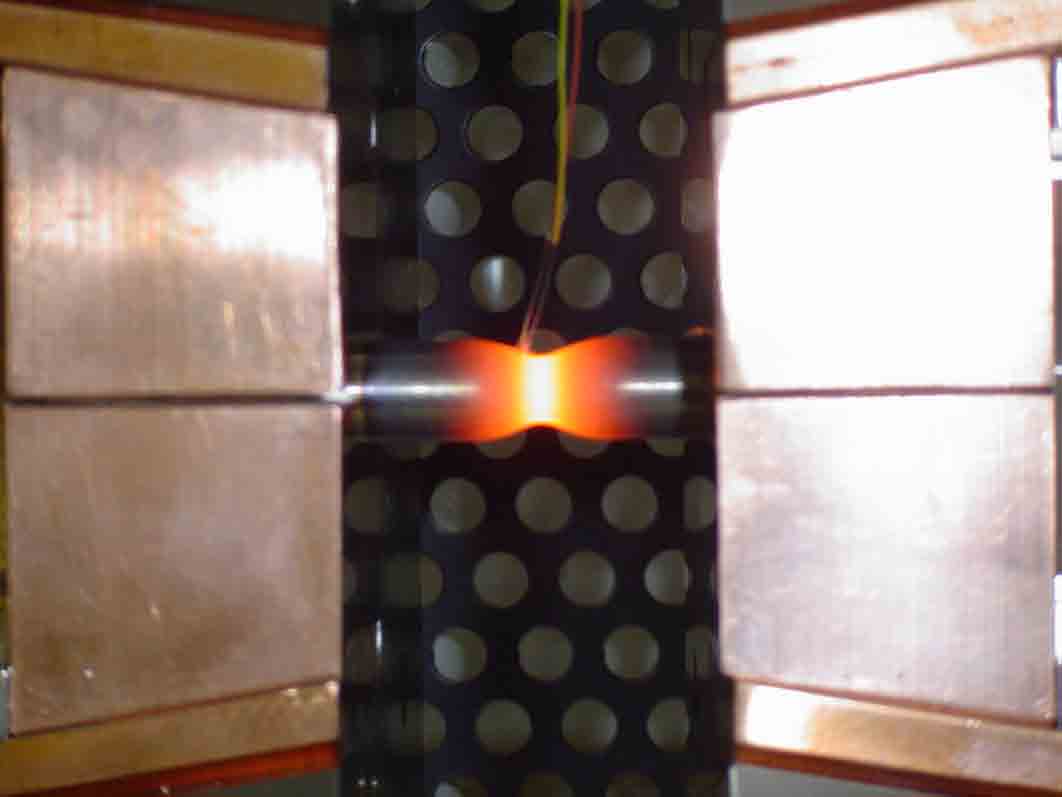
Unlike static mechanical testing, ductility is not a fixed material property. It is highly dependent on temperature, strain rate, and processing history — meaning ambient laboratory measurements often fail to predict behavior during continuous casting, welding, hot rolling, or additive manufacturing post-processing. A material that appears adequately ductile at room temperature may pass through a ductility trough at elevated temperature where cracking risk is severe. The Gleeble captures this behavior by performing tensile deformation under precisely controlled thermal cycles, producing on-heating and on-cooling ductility curves that map the full range of process-relevant conditions.
For steel producers, weld engineers, and alloy developers working with materials where cracking susceptibility determines product quality and process yield, this distinction is critical. The nil ductility temperature, the ductility recovery temperature, and the width of the brittle temperature range are properties that only emerge from thermally coupled testing — and the Gleeble has been the industry standard for this measurement for decades.
Pain Points We Solve
- Ambient ductility data that fails to predict hot cracking or casting defects — the Gleeble tests across the full thermal cycle your process imposes, including during solidification and phase transformation
- No clear process window for forming, straightening, or bending operations — the Gleeble maps ductility across temperature to identify safe and unsafe operating ranges
- Weld procedure qualification based on incomplete HAZ characterization — Gleeble hot ductility testing evaluates liquation cracking susceptibility with on-heating and on-cooling curves under controlled thermal profiles
- Alloy development slowed by trial-and-error composition screening — the Gleeble quantifies how individual alloying elements affect hot ductility from small laboratory specimens before committing to production heats
- Production defects with no clear root cause — the Gleeble replicates the exact thermal-mechanical history of a defective component to isolate contributing factors and validate corrective actions
Comprehensive Ductility Property Characterization
This dataset captures material ductility behavior across the full range of thermally and mechanically relevant conditions. Reduction in area and elongation at fracture quantify plastic deformation capacity as a function of temperature, strain rate, and thermal history — forming the basis of hot ductility curves used in process design. The nil ductility temperature (NDT) and ductility recovery temperature (DRT) define the brittle temperature range, enabling secondary cooling strategy development for continuous casting and straightening operations.
On-heating and on-cooling ductility curves distinguish between solidification-range cracking mechanisms and solid-state precipitation effects, informing both alloy design and welding procedure development. HAZ liquation cracking susceptibility assessment supports weld procedure qualification and preheat requirement definition. Microalloy carbonitride precipitation effects — including the detrimental influence of niobium, vanadium, and titanium on ductility trough depth and width — are quantified to guide composition optimization. Fracture morphology analysis, correlated with ductility measurements across temperature, identifies the transition between ductile intergranular and brittle intergranular failure modes for mechanistic understanding and material development.
The Gleeble Advantage: Advanced in Ductility Testing
Standard tensile frames equipped with furnaces or induction heaters can perform elevated-temperature ductility measurements. What they cannot do is reproduce the rapid thermal transients, precise cooling rates, and coupled dilatometric measurements that define a material's actual microstructural state at the moment of fracture.
The Gleeble Physical Simulation System is not simply a high-temperature ductility tester. It is a complete physical simulation platform that replicates the industrial process sequence a material experiences from casting through final forming, with the ductility test representing one configurable measurement within that broader simulation capability.
- The only commercial system that combines direct resistance heating, closed-loop servo-hydraulic mechanical control, and dilatometry in a single integrated platform
- Thermal control accuracy of ±0.1°C throughout the specimen gauge length, enabling reproducible results across test campaigns and between laboratories
- The established industry standard for hot ductility testing in continuous casting and welding susceptibility research, with decades of peer-reviewed validation
- Validated against industrial process conditions across steel, aluminum, titanium, nickel, copper, and refractory alloy systems by hundreds of global research institutions
- Supports ductility, tensile, compression, torsion, weld simulation, HAZ simulation, continuous cooling transformation (CCT), isothermal transformation (TTT), and more — all on one platform
- Data outputs are directly compatible with leading FEM packages including DEFORM, Simufact, Forge, and ABAQUS for constitutive model development
Published Research Using Gleeble Ductility Testing
Explore a selection of published studies that demonstrate how Gleeble ductility testing is used to assess material formability and fracture behavior under controlled thermal and mechanical conditions. These real-world applications highlight the system’s role in understanding material limits, optimizing processes, and generating reliable, high-quality data across a wide range of industries.
- Gleeble Hot Ductility Tests for Determination of the Strain vs Reduction of Area Relationship L.P. Karjalainen
- Experimental and numerical study on the tensile ductility of an aluminium alloy with heat-affected zones Sigurd Aune, David Morin, Magnus Langseth, Arild Holm Clausen
- Hot ductility and microstructure in casted 2205 duplex stainless steels G.W. Fan, J. Liu, P.D. Han, G.J. Qiao
- Effect of different solution heattreatments on hot ductility of superalloys Part 2 – Allvac 718 Plus J Andersson, G P Sjöberg, and M Chaturvedi
- New measurement technique of ductility curve for ductility-dip cracking susceptibility in Alloy 690 welds Kota Kadoi, Takanori Uegaki, Kenji Shinozaki, Motomichi Yamamoto

READY TO ADVANCE YOUR DUCTILITY TESTING PROGRAM?
Connect with our applications engineers to discuss your specific testing requirements and discover how a Gleeble system can transform your laboratory's capabilities.