


HIGH-PRECISION TENSILE TESTING
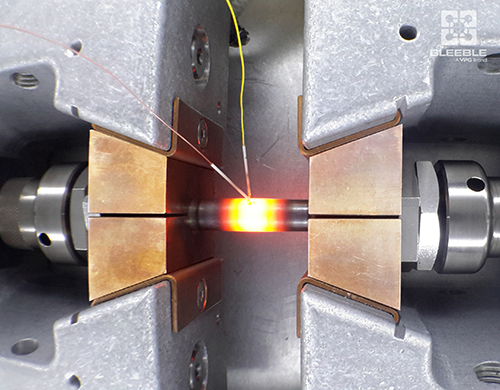
The Gleeble System enables advanced materials tensile testing under conditions that mirror your actual manufacturing process — not just a controlled laboratory environment. Configured specifically for your research objectives, the Gleeble delivers the thermal-mechanical fidelity that standard test frames cannot.
What Is Tensile Testing?
Tensile testing — also called a tension test or pull test — is a fundamental mechanical characterization method in which a material specimen is subjected to a controlled, uniaxial tensile force until it fractures. As the specimen is pulled apart, the applied force and resulting deformation are recorded continuously, producing a stress-strain curve that represents the mechanical fingerprint of that material.
The stress-strain curve reveals several critical material properties in a single test. In the elastic region, stress increases linearly with strain, and the material returns to its original shape if the load is removed. Beyond the yield point, plastic deformation begins — the material will not fully recover when unloaded. As loading continues, the material reaches its Ultimate Tensile Strength (UTS) — the peak stress it can sustain — before necking and eventual fracture.
For materials used in demanding industrial applications — structural steels, aerospace alloys, nuclear pressure vessel materials, or pipeline grades — this data determines whether a material is fit for purpose. But when that material is processed through welding, casting, rolling, or forming, its properties are no longer those of the virgin material. Tensile testing during or after simulated process cycles, as enabled by the Gleeble, provides the complete picture.
Pain Points We Solve
- Ambient-only test data that doesn't predict real-process behavior — the Gleeble tests at any temperature, including during controlled thermal transients
- Multiple instruments for one material study — the Gleeble performs tensile, compression, weld simulation, dilatometry, and more on a single configurable platform
- FEM models built on incomplete constitutive data — the Gleeble generates the flow stress and hot strength data needed to populate high-fidelity simulation models
- Off-the-shelf instruments that don't match your research needs — every Gleeble system is individually configured to your specific materials, testing protocols, and laboratory environment
- Inability to replicate hot cracking or ductility-dip conditions — Gleeble hot ductility testing is the industry standard for continuous casting and welding susceptibility studies
Comprehensive Tensile Property Characterization
This dataset captures material behavior under tensile loading, including yield strength and elastic modulus (onset of plastic deformation and stiffness) and ultimate tensile strength (UTS) (maximum stress prior to necking) for structural design and safety factor definition. Ductility, elongation, and reduction in area quantify plastic deformation and formability, informing fracture behavior and strain localization.
Tensile testing across temperatures provides hot strength and hot ductility, enabling evaluation under thermal and processing conditions. Flow stress and strain rate sensitivity define material response across deformation regimes, supporting constitutive modeling (e.g., Johnson-Cook) for simulation. Finally, fracture morphology and failure mode analysis, correlated with tensile data, identifies ductile, brittle, or intergranular behavior for material development and failure investigation.
The Gleeble Advantage: Advanced Tensile Testing
There is no shortage of tensile testing systems on the market. Universal test frames, electromechanical load cells, and hydraulic testing machines are widely available. What they cannot do is simulate the thermal-mechanical history that determines a material's microstructure — and therefore its properties — at the moment of testing.
Gleeble Systems are not simply a high-temperature tensile tester. It is a complete physical simulation platform that replicates the industrial process sequence experienced by a material from raw form to final component — with the tensile test representing one configurable measurement within that broader simulation capability.
- The only commercial system that combines direct resistance heating, closed-loop servo-hydraulic mechanical control, and dilatometry in a single integrated platform
- Thermal control accuracy of ±0.1°C throughout the specimen gauge length, enabling reproducible results across test campaigns and between laboratories
- Validated against industrial process conditions across steel, aluminum, titanium, nickel, copper, and refractory alloy systems by hundreds of global research institutions
- Supports tensile, compression, torsion, fatigue, fracture, weld simulation, HAZ simulation, continuous cooling transformation (CCT), isothermal transformation (TTT), and more — all on one platform
- Data outputs are directly compatible with leading FEM packages including DEFORM, Simufact, Forge, and ABAQUS for constitutive model development
- Decades of peer-reviewed publications and industry case studies validating Gleeble physical simulation data against full-scale industrial trials
Published Research Using Gleeble Tensile Testing
Explore a selection of published studies that showcase how Gleeble tensile testing is used to evaluate material behavior under controlled thermal and mechanical conditions. These real-world applications highlight the system’s role in advancing research, validating processes, and generating reliable, high-quality data across a range of industries.
- A Coupled Electrical–Thermal–Mechanical Modeling of Gleeble Tensile Tests for Ultra-High-Strength (UHS) Steel at a High Temperature C. Zhang, M. Bellet, M. Bobadilla, H. Shen, B. Liu Metallurgical and Materials Transactions A, Vol. 41, pp. 2304–2317, 2010. DOI: 10.1007/s11661-010-0310-7
- Investigation of the Effects of Thermal Gradients Present in Gleeble High-Temperature Tensile Tests on the Strain State for Free Cutting Steel E. Kardoulaki, J. Lin, D. Balint, D. Farrugia Journal of Strain Analysis for Engineering Design, 2014. DOI: 10.1177/0309324714531950
- Temperature Distribution in the As-Cast Steel Specimen During Gleeble Hot-Tensile Test and Its Effect on High-Temperature Mechanical Properties Wenxiang Jiang, Mujun Long, Dengfu Chen, Songyuan Ai & Huamei Duan Metallurgical and Materials Transactions B, Vol. 52, No. 3, pp. 1228–1242, June 2021. DOI: 10.1007/s11663-021-02071-3
- Tensile Behavior of a Slurry Fe-Cr-Si Coated Nb-Alloy Evaluated by Gleeble Testing M.K. Kumawat, Z. Alam, A. Kumar, K. Gopinath, S. Saha, V. Singh, V. Srinivas, D. Das Surface & Coatings Technology, Vol. 349, pp. 695–706, 2018. DOI: 10.1016/j.surfcoat.2018.07.042
- Influence of Gauge Length on Tensile Curves of Gleeble High-Temperature Tensile Samples G. Zhao, D. Wu, S. Liu, et al. Experimental Technology and Management, Vol. 41, No. 8, pp. 15–21, August 2024. DOI: 10.16791/j.cnki.sjg.2024.08.002

READY TO ELEVATE YOUR TENSILE TESTING CAPABILITY?
Talk to a Gleeble application engineer about configuring a system for your materials, your laboratory, and your research objectives. Every Gleeble testing success starts with a conversation about your specific needs — not a product brochure.