

DIRECT RESISTANCE HEATING SYSTEM
The Secret Behind Gleeble’s Ultra-High Temperature Testing: Direct Resistance Heating for Materials Testing
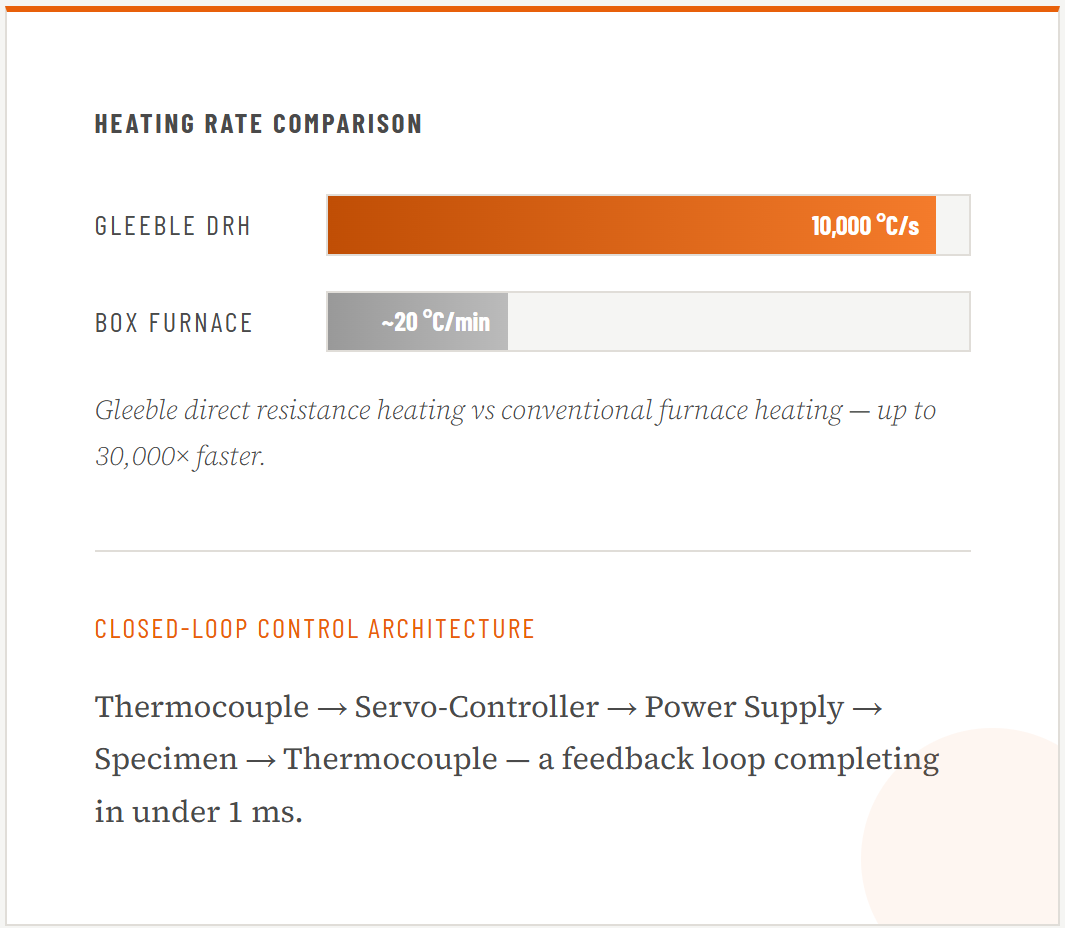
Gleeble direct resistance heating delivers closed-loop thermal control at heating rates up to 10,000°C/s — enabling thermo-mechanical testing, physical simulation heating, and ultra-high-temperature materials testing that traditional furnace methods simply cannot match. Replicate real-world thermal profiles with unrivalled accuracy, repeatability, and speed.
TECHNOLOGY EXPLAINED
WHAT IS DIRECT RESISTANCE HEATING?
Direct resistance heating is a method of heating a conductive specimen by passing high electrical current directly through it.
Unlike conventional furnace heating — which relies on convective or radiative heat transfer from an external source — direct resistance heating generates heat within the specimen itself, at the point of interest.
The result is extraordinary: heating rates orders of magnitude faster than any furnace, with thermal gradients that can be precisely shaped and controlled across the gauge length.
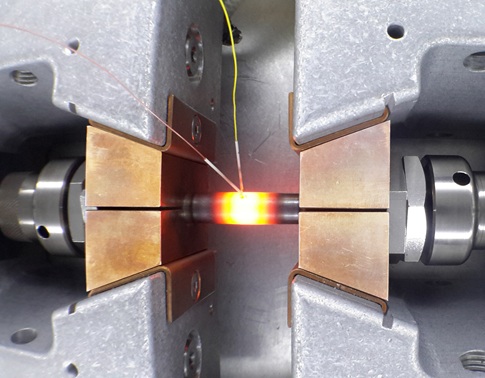
In a Gleeble system, this is achieved through a patented closed-loop direct resistance heating system where thermocouples welded to the specimen surface feed real-time temperature data back to a servo-controller — adjusting current delivery in milliseconds to maintain the programmed thermal profile with ±1°C accuracy.
This capability is fundamental to physical simulation: you cannot replicate industrial thermal histories — such as rolling passes, quench-and-temper cycles, or continuous casting gradients — using furnace heating. Only direct resistance heating delivers the speed, fidelity, and closed-loop precision required.

SEE GLEEBLE DIRECT RESISTANCE HEATING WORKING IN YOUR APPLICATION
Whether you are qualifying a new alloy, building a constitutive database, or optimizing a production heat treatment, Gleeble systems deliver the speed, precision, and scientific rigor your program demands. Talk to our applications engineers today.
HEATING RATE COMPARISON
CORE CAPABILITIES
Engineering-Grade Heating Capabilities. Built for the Most Demanding Tests.
Every Gleeble resistance heating system is engineered to deliver repeatable, programmable thermal profiles — from rapid quench to isothermal holds — with the precision industrial and academic researchers demand.

High-Speed Heating & Cooling Rates
Achieve heating rates up to 10,000°C/s and fast quench cooling rates that replicate industrial process conditions — from continuous casting to rapid die quenching — within a single test cycle.

Closed-Loop Resistance Heating Control
Servo-controlled current delivery responds to welded thermocouple feedback in real time, maintaining programmed temperature within ±1°C across all heating, soaking, and cooling phases.

Ultra-High Temperature Testing
Gleeble systems routinely operate above 1,700°C, enabling physical simulation of refractory metals, superalloys, ceramics, and advanced high-temperature structural materials under controlled mechanical load.

Uniform Specimen Heating with ISO-T Anvil System
The Gleeble ISO-T anvil system creates an isothermal plane at the specimen center, extending the uniform hot zone for uniaxial compression testing and reducing thermal gradient effects on microstructural results.

Thermal Profile Simulation & Replication
Import real industrial thermal histories — recorded from thermocouples on production plant — and replay them with exact fidelity in the lab. Validate predictions, optimize process parameters, and reduce costly plant trials.

Simultaneous Thermo-Mechanical Loading
Apply uniaxial tension, compression, or torsion simultaneously with precisely controlled thermal cycles — enabling authentic thermo-mechanical testing of flow stress, hot workability, and phase transformation behavior.

Fast Quench Heating & Quenching
Integrated quench capabilities — gas, water mist, or die contact — allow rapid cooling from peak temperature immediately following hot deformation, supporting HAZ simulation, quench-and-temper studies, and CCT/TTT diagram generation.

CCT Curve Generation & TTT Diagram Simulation
Run continuous cooling transformation and time-temperature-transformation experiments across defined parameter matrices. Generate complete CCT curves and TTT diagrams for alloy development in a fraction of the time required by dilatometry alone.

Vacuum & Controlled Atmosphere Compatibility
Perform physical simulation heating in vacuum, inert gas, or reactive atmospheres — essential for reactive metals such as titanium, zirconium, and refractory alloys where surface oxidation must be eliminated.

EXPLORE THE NEXT GENERATION OF MATERIALS TESTING
Download the Gleeble Systems brochure to accelerate development and optimize your processes. Get the insights you need to improve quality and move faster.
FEATURE SPOTLIGHT
The Gleeble ISO-T Anvil System: Uniform Specimen Heating Redefined
Achieving truly uniform specimen heating during uniaxial compression testing has historically been one of the central challenges in physical simulation. The Gleeble ISO-T anvil system solves this by actively heating the contact anvils to match specimen temperature, establishing a defined isothermal plane at the gauge centre.
The result is a significantly enlarged uniform hot zone, more homogeneous deformation, reduced friction effects, and constitutive data that can be directly applied to FEM simulation without correction factors — a critical advantage for alloy developers and process modelers alike.
- Extends uniform temperature zone by up to 3× versus standard tooling
- Reduces friction-driven barreling for more accurate flow stress measurement
- Compatible with all Gleeble 3500, 3800, and 3800-GTC platforms
- Supports vacuum and inert atmosphere testing of reactive alloys
- Integrated with Gleeble QuikSim software for automated test execution
- Validated for uniaxial compression testing per ASTM and ISO protocols
Where Gleeble Direct Resistance Heating Delivers Competitive Advantage
From primary metals producers to aerospace research laboratories, Gleeble systems are deployed wherever materials processing simulation demands speed, accuracy, and scientific credibility.
Hot Workability Testing
Determine the workable temperature-strain rate window for alloys under development using hot compression and tension tests. Processing maps generated from Gleeble data are industry-standard inputs for rolling mill, forging press, and extrusion process design. Real-world example: superalloy forging houses use Gleeble hot workability data to set billet preheat and forging window specifications.
Continuous Cooling Transformation (CCT) & TTT Diagrams
Generate complete CCT curves and TTT diagrams for steel and aluminum alloy development programs. The high-speed heating and cooling rates of Gleeble direct resistance heating allow large matrices of cooling rate conditions to be tested rapidly, dramatically reducing alloy qualification timelines versus traditional dilatometry.
Weld HAZ Physical Simulation
Reproduce the thermal cycles experienced by material in the heat-affected zone of industrial welds — from fusion boundary to outer HAZ regions — on standard tensile or Charpy specimens. Quantify the effect of peak temperature, heat input, and inter-pass temperature on toughness, hardness, and microstructure without consuming production weld plate.
Continuous Casting Solidification Simulation
Simulate the thermal history of strand material from liquidus through straightening temperature using Gleeble's high-speed heating capability to re-melt and resolidify specimens under defined conditions. Evaluate hot tearing susceptibility, segregation, and hot ductility — a key factor in slab and billet quality optimization.
Heat Treatment Process Optimization
Trial quench-and-temper, solution-treat-and-age, and thermomechanical processing (TMCP) schedules on small specimens before committing to full-scale plant runs. Thermal profile simulation on a Gleeble system enables rapid parameter screening, reducing heat treatment development cycles from months to weeks.
Advanced High-Strength Steel & Alloy Development
Research institutions and OEM alloy development teams use Gleeble physical simulation heating to characterize austenite grain growth, recrystallisation kinetics, and precipitation behavior as a function of thermo-mechanical variables — building the datasets needed for physically-based computational models.
Gleeble Direct Resistance Heating — Key Performance Data
Performance specifications for Gleeble 3800-GTC and 3500 Series. Contact DSI for full datasheets and configuration options tailored to your application.
|
Parameters |
Gleeble 3800-GTC | Gleeble 3500-GTC | Traditional Furnace |
| Thermal | |||
|
Max. Heating Rate |
10,000 °C/s | 10,000 °C/s | ~20 °C/min |
|
Max. Test Temperature |
3000 °C | 3000 °C | Typically <1,200 °C |
|
Temperature Control |
Closed-loop, ±1 °C |
Closed-loop, ±1 °C | ±5–20 °C (setpoint) |
|
Cooling Rate |
10,000 °C/s | 10,000 °C/s | Uncontrolled / slow |
| Mechanical | |||
|
Heating Mechanism |
Direct resistance heating | Direct resistance heating | Convection / radiation |
|
Simultaneous Mechanical Load |
Yes | Yes | Limited / external |
|
Atmosphere Control |
Vacuum / inert gas / air | Vacuum / inert gas / air | Air or sealed atmosphere |
| Format | |||
|
Thermal Profile Replication |
Full industrial profile import | Full industrial profile import | Not available |
|
ISO-T Anvil Compatibility |
Yes — standard | Yes — standard | N/A |

CURIOUS ABOUT THE GLEEBLE DIRECT RESISTANCE HEATING SYSTEM?
From system capabilities and testing applications to setup, operation, and support—find clear, expert answers to help you move forward with confidence. Browse the FAQ to get the insights you need, fast.
STILL HAVE QUESTIONS? CONTACT OUR TEAM
We can help select the best Direct Resistance heating system for your needs.