


CONTROLLED THERMAL-MECHANICAL SIMULATION FOR ADVANCED MATERIALS AND METALLURGICAL RESEARCH
The Gleeble system for R&D empowers research institutions to study materials behavior under thermal and mechanical load with unmatched fidelity — accelerating discovery, supporting graduate training, and strengthening grant applications.
Research Institutions Demands More Standard Material Testing Can Deliver
Modern materials science research operates at the frontier of what is measurable. Studying microstructure evolution under thermal cycles, quantifying mechanical properties at extreme temperatures, or reproducing manufacturing process conditions in a controlled laboratory setting — these goals demand specialized, purpose-built equipment.
Universities, national laboratories, and independent research institutes face compounding pressures: produce publishable, reproducible data; train the next generation of materials engineers; and justify capital expenditures to grant agencies. Conventional tensile frames and furnaces fall short of the precision, thermal control, and multivariable capability that cutting-edge research requires.
Gleeble thermo-mechanical simulation systems were built for exactly this environment — delivering research-grade materials science lab equipment that satisfies peer-review rigor while generating results industry partners trust.

TALK TO AN EXPERT ON METALLURGICAL RESEARCH
Ready to validate critical components and accelerate certification? Contact our team to discuss your automotive testing and simulation needs.
CORE CAPABILITIES
Complete Physical Simulation Platform For Mechanical Research
Every Gleeble system integrates direct-resistance heating, precision hydraulic loading, and real-time closed-loop control into a single, research-ready platform. These capabilities address the full spectrum of materials characterization challenges facing research institutions today.

Material Behavior & Microstructure CHaracterization
-
Microstructure evolution: grain growth, recrystallization, phase transformations
-
CCT and TTT diagram generation
-
Hot deformation and flow stress characterization
-
Dilatometry for phase fraction and transformation detection
-
Specimens prepared for SEM, EBSD, TEM, and XRD analysis
Precision Thermal & Thermo-Mechanical Control
-
Controlled heating and cooling from ambient to 1,700°C
-
Heating rates up to 10,000°C/s with closed-loop feedback
-
Simultaneous thermal and mechanical loading (tension, compression, torsion)
-
Strain rate control from quasi-static to dynamic
-
Gas quenching and isothermal holds with high stability
Process Simulation & Digital Integration
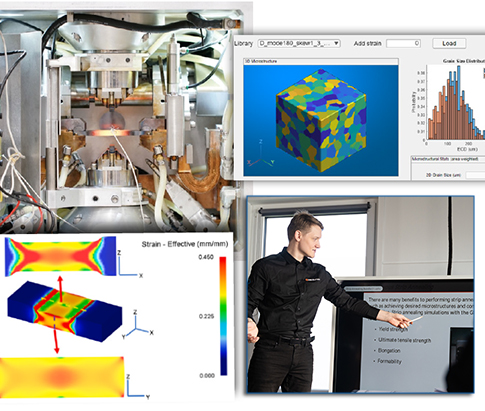
Gleeble bridges physical testing and computational modeling by replicating industrial processes and producing validated data for simulation, accelerating materials and process development.
-
Weld Simulation & HAZ Analysis
-
Materials Database & Process Modeling Integration
The Gleeble Advantage: Why Research Institutions Choose Gleeble for Physical Simulation
Physical simulation accelerates materials R&D by collapsing the gap between process design and experimental validation. With Gleeble, researchers generate actionable, publication-ready data in days rather than months. Gleeble accelerates the development and qualification of specialty materials by replacing slow, trial-and-error testing with precise physical simulation. Researchers can systematically map processing windows—identifying optimal thermal and deformation parameters on small-scale specimens before scaling to production—reducing reliance on costly industrial trials and compressing qualification timelines by as much as 40–60%. By reproducing real process conditions in the lab and generating both physical specimens and high-quality data, Gleeble enables faster, iterative design cycles while directly supporting computational model validation.
In academic environments, Gleeble also serves as a powerful platform for both research output and workforce development. It enables high-impact publications and industry collaboration while giving graduate students hands-on experience with real-world thermo-mechanical testing and data interpretation. At the institutional level, access to advanced physical simulation capabilities strengthens grant proposals by demonstrating the infrastructure needed to execute complex materials research, helping universities secure funding and attract top-tier talent.
Proven Solutions for Research Institutions
From fundamental metallurgical studies to applied process optimization, Gleeble systems are at work in leading research institutions across six continents. These applications represent the breadth of materials science discovery that Gleeble enables.
Superalloy & High-Temperature Materials Research
Research institutions supporting aerospace and energy sectors use Gleeble to characterize nickel-based superalloys, titanium alloys, and refractory metals under the extreme temperature and strain conditions that define turbine blade and pressure vessel applications.
High-temperature materials testing up to 3000°C — with simultaneous mechanical loading — provides constitutive data essential for creep modeling, dynamic recrystallization studies, and gamma-prime dissolution kinetics research.
Additive Manufacturing Process Simulation
As additive manufacturing scales toward structural applications, research groups are using Gleeble to replicate the rapid, multi-cycle thermal histories of laser powder bed fusion and directed energy deposition processes on bulk specimens — enabling microstructure evolution and residual stress studies at a scale impossible within the AM machine itself.
This capability is particularly valuable for comparing as-built versus heat-treated AM microstructures and for developing post-process heat treatment schedules validated against real material response.
Welding Metallurgy & HAZ Characterization
Universities with active welding research programs rely on Gleeble to simulate the complex, multi-cycle thermal histories experienced by heat-affected zone (HAZ) subregions in multi-pass welds. This enables production of large, uniform HAZ microstructures for mechanical testing that are physically impossible to extract from actual weldments.
Advanced High-Strength Steel Development
Research groups studying third-generation AHSS use Gleeble to map hot deformation behavior, optimize intercritical annealing cycles, and simulate quench-and-partition processing — generating CCT diagrams and flow stress data essential for forming simulation input decks.
Controlled heating and cooling rate capability allows precise replication of industrial continuous annealing furnace profiles on laboratory specimens, enabling direct comparison between simulated and production microstructures.
Academic Research Papers Using Gleeble
Gleeble-Enabled Science in Peer-Reviewed Literature
More than 30,000 published studies across materials science, metallurgical engineering, and manufacturing research cite Gleeble systems as the primary experimental platform.
-
Research papers about different academic-related things/companies
-
Research papers about different academic -related things/companies
-
Research papers about different academic -related things/companies
 Equip Your Institution for Materials Research That Sets the Standard
Connect with a Gleeble applications specialist to discuss how a Gleeble system for R&D fits your research program, budget structure, and grant requirements.