


DIGITAL IMAGE CORRELATION SYSTEM
Full-Field 3D Digital Image Correlation System for High-Temperature Materials Testing up to 2000°C
The DIC measurement system, provided by our partners at Tecnar and GOM, deliver non-contact optical strain measurement across the entire specimen surface — capturing strain gradients, localized necking, and complex deformation that contact extensometers simply cannot see. Fully integrated with the Gleeble thermo-mechanical simulation platform for testing at temperatures from ambient up to 2000°C.
What Is Digital Image Correlation and How Does It Work?
Digital Image Correlation (DIC) is a 3D, full-field, non-contact optical measurement technique that tracks micro-displacements across an entire specimen surface — delivering complete strain field maps where traditional contact gauges provide only a single average value.
A high-contrast speckle pattern is applied to the specimen surface before testing begins. As the specimen deforms under load and thermal cycling, a calibrated stereo camera system captures images at high speed. Proprietary image processing software compares successive frames, tracking the unique intensity patterns within small subsets of pixels to compute displacement vectors at every point simultaneously.
The result is a dense matrix of full-field deformation measurements — transformed into strain maps, principal strain fields, and strain gradient plots.
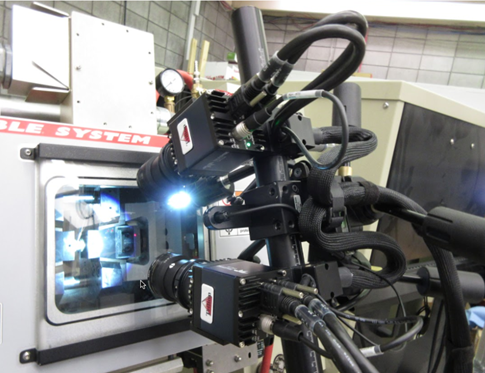
Unlike a contact extensometer, which collapses all deformation between two points into a single number, DIC resolves exactly where and how deformation is occurring across the entire gauge region.
"DIC systems provide full-field measurements across a specimen allowing characterization of strain fields in an entire test region. Traditional contact measurement systems provide only 2-point strain measurements — from one point to another point."
For Gleeble thermo-mechanical simulation, this capability is transformative. Hot-zone temperature gradients in resistance-heated specimens inevitably create non-uniform deformation — precisely the kind of complex strain field that DIC was designed to characterize.

READY TO SEE THE FULL PICTURE?
The result is a dense matrix of full-field deformation measurements — transformed into strain maps, principal strain fields, and strain gradient plots.
How DIC Works — Process Overview

01 - Apply Speckle Pattern
High-contrast random pattern applied to specimen surface using heat-resistant coating suitable for high-temperature testing environments.

02 - Stereo Camera Acquisition
Calibrated high-speed stereo cameras capture synchronized image pairs throughout the entire test cycle at programmable frame rates.

03 - Subset Correlation Algorithm
Software divides each image into subsets and tracks unique intensity patterns to compute 2D displacement fields in each camera view.

04 - 3D Reconstruction
Stereo photogrammetry triangulates displacement vectors into 3D surface deformation data, correcting for out-of-plane motion.

05 - Full-Field Strain Output
Strain tensors computed at every data point across the specimen surface — exported as strain maps, time histories, and quantitative data sets.

LOOK DEEPER AT HIGH-TEMPERATURE DEFORMATION
Download the Gleeble brochure to optimize your visualization capabilities. Get the visibility you need to improve your quality and measurements.
|
Specifications |
Gleeble DIC System |
| System Tolerances | |
| Maximum Operating Temperature | Up to 2000°C (application-dependent) |
| Measurements | |
|
Measurement Type |
3D full-field, non-contact optical |
| Strain Measurement | Full-field: εxx, εyy, εxy, principal strains, von Mises equivalent |
|
Spatial Resolution |
Sub-millimeter; subset size configurable per application |
| Configuration | |
|
Camera Configuration |
Calibrated stereo pair; high-speed, high-resolution sensors |
|
Illumination |
High-intensity narrow-spectrum LED; bandpass-filtered |
| Software | Licensed professional DIC analysis software suite |
|
Data Synchronization |
Synchronized with Gleeble QuikSim control and data acquisition |

CURIOUS ABOUT DIC?
From system capabilities and testing applications to setup, operation, and support—find clear, expert answers to help you move forward with confidence. Browse the FAQ to get the insights you need, fast.
STILL HAVE QUESTIONS? CONTACT OUR TEAM
We can help you look into applying the DIC system for your measurement needs.