

GLEEBLE LUMET SYSTEM
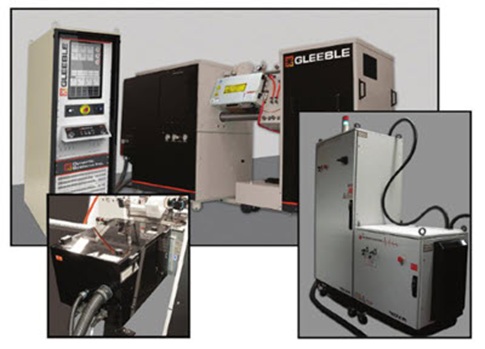
LUMet: Laser-Ultrasonic real-time in situ measurement for recrystallization, grain growth, & phase transitions. Advanced non-contact ultrasonic characterization of materials during critical Metallurgical processes.
Transform your materials testing with the Gleeble LUMet System® —the industry's most advanced laser-ultrasonics solution for real-time in situ measurement of grain size, recrystallization kinetics, phase transitions, and elastic constants during high-temperature thermo-mechanical simulation. Achieve unprecedented insights into microstructure evolution without destroying your samples.

TRANSFORM YOUR MATERIALS DEVELOPMENT PROCESS
Discover how the Gleeble LUMet system can accelerate your research, optimize your processes, and deliver deeper metallurgical insights than ever before.
FEATURES AT A GLANCE

Real-Time Process Intelligence
Monitor microstructure changes as they happen during heating, deformation, and cooling cycles—no waiting for post-test metallography.
Non-Destructive Analysis
Preserve your valuable specimens while obtaining complete metallurgical data through non-contact laser-based ultrasonic testing.

In Situ Characterization
Capture austenite to ferrite transformations, grain boundary migration, and recrystallization kinetics during actual processing conditions—not after.

Process-Integrated Monitoring
Seamlessly integrate with Gleeble systems to correlate thermo-mechanical parameters with metallurgical evolution for steel production, heat treatment, and continuous casting optimization.
WHY MATERIALS SCIENTISTS CHOOSE LUMET
Traditional metallurgical testing forces you to choose between speed and accuracy. Destructive metallography requires cutting, mounting, polishing, and etching—destroying your specimen and adding days to your testing cycle. Offline characterization misses critical transient phenomena that occur only during high-temperature processing.
The Gleeble LUMet (Laser Ultrasonic Measurement) System eliminates this compromise. By integrating advanced laser-ultrasonics directly with your Gleeble thermo-mechanical simulator, LUMet delivers real-time, in situ measurement of grain size, recrystallization, phase transformations, and elastic properties—all while your test is running. This means you can optimize hot rolling microstructure control, validate continuous casting models, and develop advanced heat treatment protocols with unprecedented efficiency and insight.
For steel producers, alloy developers, and materials researchers facing pressure to accelerate development cycles while improving product quality, LUMet represents a paradigm shift in how metallurgical processes are understood and optimized.
CORE CAPABILITIES THAT TRANSFORM MATERIALS TESTING
LUMet integrates seamlessly with Gleeble systems to provide comprehensive, non-destructive metallurgical characterization during thermo-mechanical simulation.

Non-Contact Laser Ultrasonic Testing
Class 1 laser safety rating with non-invasive measurement—no transducers, couplants, or physical contact that could alter specimen behavior or thermal profiles.

Real-Time Grain Size Measurement
Track grain growth and refinement dynamics continuously throughout heating, deformation, and cooling cycles with sub-second temporal resolution.

In Situ Phase Transformation Detection
Identify austenite to ferrite transformations, martensite formation, and other phase transitions as they occur based on ultrasonic velocity and attenuation changes.

Recrystallization Kinetics Analysis
Measure static and dynamic recrystallization onset, progression, and completion in real-time to optimize thermo-mechanical processing windows.

Elastic Constants Determination
Calculate temperature-dependent elastic moduli and Poisson's ratio from ultrasonic wave velocity measurements for constitutive modeling and FEA validation.

High-Temperature Capability
Operate reliably up to 1,300°C (2,372°F) to characterize materials under authentic hot rolling, forging, and heat treatment conditions.

Multi-Specimen Compatibility
Test round specimens (10-12mm diameter) and flat specimens (1-15mm thickness) to match your specific application requirements.

Synchronized Data Acquisition
Automatically correlate ultrasonic measurements with temperature, strain, and force data from the Gleeble system for comprehensive process understanding.

Advanced Materials Characterization
Applicable to steels, aluminum alloys, titanium alloys, nickel-based superalloys, and other engineering materials critical to aerospace, automotive, and energy industries.

DEEP DIVE: LUMET TECHNOLOGY WHITE PAPER
Access our comprehensive technical white paper detailing the physics of laser-ultrasonic measurement, validation studies, application examples, and data interpretation guidelines. Essential reading for materials scientists implementing in situ characterization in their research programs.
Technical Specifications
Engineered for precision and reliability in demanding metallurgical research and industrial environments.
|
Specifications |
Gleeble LUMet |
|
Light Amplification |
|
|
Laser Class |
Class 1 (Safe for operator exposure) |
| Specimen Capacity | |
|
Round Specimen Diameter |
10 - 12 mm |
|
Flat Specimen Thickness |
10 - 12 mm |
|
Temperature Control |
|
|
Maximum Heating Rate |
100°C/s (180°F/s) |
| Maximum Temperature | 1,300°C (2,372°F) |
|
System Tolerances |
|
|
Maximum Stroke Rate |
4 mm/s (0.157 in/sec) |
|
Recommended Stroke Rate |
2 mm/s (0.0787 in/sec) |
|
Power Requirement |
|
|
LUMet Power Supply |
240 VAC (supplied from Gleeble load unit) |
|
Cooling Rates |
|
| Cooling Process Fluid Flow Rate | 18.9 L/min ± 1 L/min (5 gpm ± 1 gpm) |
| Cooling Process Fluid Temperature | 20 - 23.9°C (68 - 75°F) |
| Cooling Process Fluid Pressure | 1.5 bar (21.75 psi) |

CURIOUS ABOUT THE GLEEBLE LUMET SYSTEM?
From system capabilities and testing applications to setup, operation, and support—find clear, expert answers to help you move forward with confidence. Browse the FAQ to get the insights you need, fast.
STILL HAVE QUESTIONS? CONTACT OUR TEAM
Let us know how we can help you select the LUMet to advance your Non-Contact Ultrasonic Characterization of Materials.